

Defence Holdings
A multi-year play.


Good Morning Team.
In 1999, Ensemble Studios and Microsoft together published the best video game of all time.
Age of Empires II.
It’s been refined over the past 27 years, but ultimately the RTS genre was perfected at a time when you still had to dial up for an internet connection - and if anyone decided to pick up the house phone, you were ‘DEFEATED.’
Anyway, I’ve thinking about the rise of technology over the past few days.
About how every major city on Earth endlessly taxed horses in a futile attempt to deal with overwhelming amounts of manure - only to see horses disappear within a couple of decades when the Ford Model T came along.
Or how whaling was abandoned in favour of petroleum products in just over a year back in 1903. Or the fact that we went from the Wright brothers to the Moon landing in just 66 years.
Sometimes I’ll be walking the dogs through the ruins of copper-tin mines in Devon, mines which could rise like Lazarus as the new world order emerges.
In my lifetime alone, we went from Snake on the Nokia 3310, to holding the sum of all human knowledge in our pockets. I can talk to anyone, almost anywhere on the planet, instantly.
And when I hit send on this article, thousands upon thousands of you will get get a notification ping on your phone.
In a fraction of a second, an electrical circuit in my desktop will convert these words into packets of trapped electrons. Those electrons will transform into infrared light pulses, racing through underwater fibre-optic cables at 200,000 kilometres per second.
When that light hits a phone mast near you, it’ll burst into electromagnetic radio waves, cutting through the air to vibrate the tiny copper antenna inside your pocket.
Your phone’s battery will then discharge its own stream of electrons, lighting up an array of organic molecules to beam photons directly into your retinas.
We went from dial-up tones breaking a medieval battle simulator to manipulating the fundamental laws of light and quantum physics just to say hello on a Tuesday morning.
The pace of what we’re building is staggering.
But with every technological advance, just as any the Real Time Strategy game, the enemy is also evolving.
And evolution is unforgiving. There’s a reason why we got to the moon so quickly.
But as long as nuclear weapons remain uninterceptable, the wars of tomorrow will be fought by keyboard warriors.
Not longbowmen.
And like the game, you can’t wholly rely on your allies.
Welcome to Sovereign AI.
And welcome back to Defence Holdings.
Last season on #ALRT
Before we get into the bull case, a warning.
Defence Holdings is a high risk, early stage growth stock. It is not suitable for widows, orphans or anyone who cannot comfortably absorb a potential loss.
It should form a modest portion of a diversified portfolio, and you should not invest here with capital you cannot afford to lose.
I really mean this. If you bought a 4p per share a few months ago, and felt psychologically uncomfortable watching it fall back to 1p, you don’t understand what you’re investing in.
This is a multi-year bet, and the share price movement will feel like you’re sitting in The Smiler, and it’s about to take off - but your lap bar won’t pull down.
However, for risk investors #ALRT is the only pure-play ticker working at the intersection of sovereign AI and defence.
Ultimately, if you want to be invested in this very in-trend theme, there’s only one way to play it.
But why is sovereign AI becoming a key investment theme NOW, months after my initial thesis?
It’s simple really.
The world has changed.
To understand why Defence Holdings matters, you first need to understand the world it was born into. The tailwind behind this company is a structural gale that has been building for years and shows no signs of abating.
For roughly three decades after the fall of the Berlin Wall, the Western world enjoyed what economists called the ‘peace dividend.’
Defence budgets were cut, troops were brought home and the prevailing assumption was that liberal democracy had won, history was over, and the tanks could be left to rust in the fields.
NATO members routinely fell below their 2% of GDP spending commitments - with Germany, haunted by its own history, allowing its military to atrophy to near irrelevance. Britain hollowed out its armed forces in successive spending reviews. The United States pivoted toward counterterrorism rather than peer competition.
That era is over.
It ended definitively on 24 February 2022, when Russian tanks crossed the Ukrainian border and the assumptions of the post-Cold War settlement dissolved overnight.
The numbers that have followed are extraordinary.
In 2025, European NATO members and Canada spent a record $574 billion (£462 billion) on defence, a 20% increase from 2025.
This collective expenditure brought their spending to 2.33% of their combined GDP, marking the first time in NATO history that every European ally met or exceeded the 2% of GDP target.
Poland has surged to over 4.8% of GDP — one of the highest proportionate spends anywhere in the world. Germany created a special €100 billion fund to modernise its armed forces. Sweden, in its first year of NATO membership, increased military expenditure by 34%.
The United Kingdom committed to raising defence spending to 2.5% of GDP by 2027, with ambitions toward 3% in the longer term.
(Yes, we know the UK is dragging its heels somewhat, however the money will have to be found.)
But the headline numbers, significant as they are, only tell part of the story. The more important shift is qualitative, not quantitative. It’s not just that more money is being spent on defence, but what that money is being spent on.
Russia’s invasion of Ukraine did not just wake NATO up to the reality of peer conflict. It rewrote the manual for what modern warfare looks like.
The lessons from the Ukrainian front lines are being absorbed by every serious military strategist in the Western alliance, and they point unmistakably in one direction: the future of warfare is software-defined, AI-enabled and dependent on information dominance as much as kinetic force.
Cheap commercial drones fitted with AI targeting systems are destroying expensive legacy hardware. Electronic warfare is shaping the battlefield as decisively as artillery. Disinformation campaigns are being weaponised to manipulate public opinion in real time.
Today alone, the BBC reported that Russia was behind the arson attacks on Starmer. That’s one single data point; you’re unaware of thousands more.
Cyber attacks are targeting critical national infrastructure — power grids, transport networks, financial systems — as a complement to or substitute for physical force.
And the speed at which decisions need to be made — the OODA loop (observe, orient, decide, act) — has compressed to the point where human decision-making alone is no longer sufficient.
This is what Al Carns, the decorated former Royal Marine Commando who served as Armed Forces Minister and who has since emerged as one of the most compelling voices in British political life, means when he says the next war will be won by ‘coders, drones, and energy independence.’

This is a doctrine.
It’s the doctrine that Defence Holdings was built to serve.
Of course, the wider global defence technology market is responding. Beyond the traditional hardware primes — BAE Systems, Raytheon, Lockheed Martin — a new category of company has emerged, focused on the software layer that makes modern military capability possible.
In the United States, Palantir has built a multi-billion dollar business providing AI-powered data analytics and decision support to the Pentagon and intelligence community. Anduril has achieved unicorn status building autonomous defence systems. Helsing, the European AI defence company, has attracted extraordinary valuations from private investors.
The International Institute for Strategic Studies estimates that global defence spending reached an all-time high of $2.63 trillion in 2025. And the proportion of that spending directed toward software, AI and digital capability is growing at an even faster rate.
In this environment, a UK-listed, software-led sovereign defence company is what the moment demands. The question is whether Defence Holdings can execute on the opportunity.
The evidence is building that they can.
But why sovereign capability?
The word ‘sovereign’ appears so frequently in Defence Holdings’ communications that like anyword repeated too often, it can start to blend into the mental background.
But ‘sovereign’ is the most strategically important word in the company’s vocabulary, and understanding why requires a brief detour into the geopolitics of technology supply chains.
The pandemic exposed, in the most brutal possible way, the fragility of global supply chains. The semiconductor shortage that paralysed automotive manufacturing, consumer electronics and defence procurement simultaneously was a masterclass in what happens when critical dependencies are concentrated in a handful of chokepoints.
Taiwan Semiconductor Manufacturing Company produces the overwhelming majority of the world’s most advanced chips. ASML, a Dutch company, is the sole manufacturer of the extreme ultraviolet lithography machines required to make those chips.
The rare earth minerals that underpin modern electronics are predominantly mined in China or in countries within China’s sphere of poltical influence.
This is a live operational reality that defence planners are grappling with right now. If China were to move against Taiwan — a scenario that looks increasingly plausible — the impact on Western defence capability would be immediate and severe.
The semiconductor supply chain, the AI compute infrastructure, the hardware that runs military communications systems — all of it passes through chokepoints that a hostile power could exploit.
The response, across the Western alliance, has been a growing emphasis on technological sovereignty - the principle that critical capabilities, particularly those related to national security and defence, must be controlled, operated and (where possible) manufactured by sovereign entities, within sovereign jurisdictions, under sovereign legal frameworks.
This principle is now embedded in UK government policy at the highest level. The Strategic Defence Review 2025 made it explicit that trusted digital infrastructure is fundamental to UK sovereignty.
The National Security Act 2023 created new legal frameworks for countering hostile state activity. The forthcoming Cyber and Electromagnetic Command represents a major organisational investment in digital warfare capabilities.
The Cyber Resilience Bill will mandate new security standards across critical infrastructure sectors.
And then there’s is the Taskforce for AI in Defence, announced by Prime Minister Keir Starmer this month — a mission-focused team charged with getting cutting-edge AI into the hands of the Armed Forces ‘safely, quickly, and responsibly,’ with a test of ‘real operational capability in months, not years.’
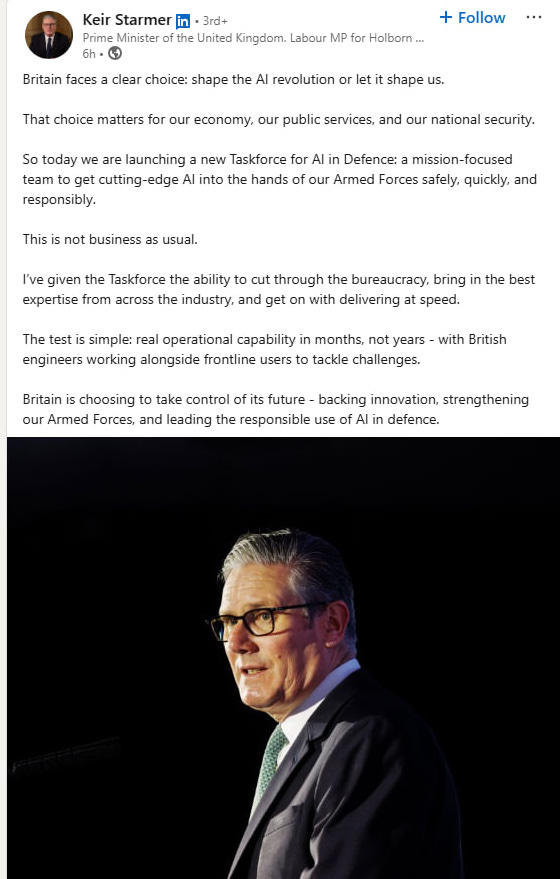
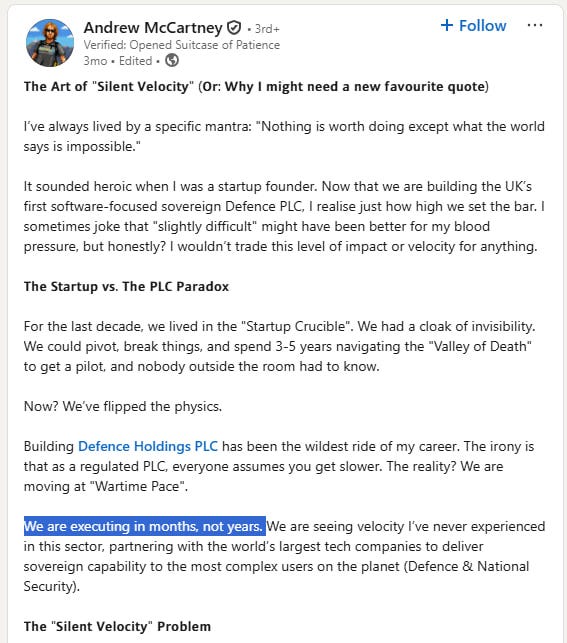
That phrase — months, not years — appeared in Defence Holdings’ own communications before it appeared in the Prime Minister’s LinkedIn post.
Andy McCartney, the company’s Chief Technology Officer, wrote explicitly about ‘executing in months, not years’ as the defining characteristic of the company’s approach. The linguistic convergence is not a coincidence, and we will return to it.
But the broader point is this: the UK government, at the very highest level, has now committed to exactly the approach that Defence Holdings has been building since its inception.
Faster procurement. Software-first capability. SME engagement. Sovereign control of data and intellectual property. These are the operating principles of a Taskforce launched by the Prime Minister himself.
The US government bluntly removing Anthropic’s bleeding edge Fable and Mythos models from the public eye (with an emphasis on non-US citizens) tells you everything you need to know.
You cannot rely on allies for this.
Defence Holdings is building what the UK government urgently needs.
So why ALRT?
Defence Holdings is the UK’s first listed, software-led defence technology company.
It listed on the Main Market of the London Stock Exchange in July 2025, following a transition from its previous business model, and raised £3.45 million in gross proceeds in connection with that transition, including £350,000 subscribed by board members — a demonstration of internal conviction.
The company operates through several interconnected structures that taken together constitute something more ambitious than a simple product company.
The first is the Defence Technologies partnership with Whitespace Global, a UK-based AI infrastructure specialist with deep roots in the most classified defence and national security environments in the country.
Whitespace has spent years building its Collective Operating System — an AI orchestration platform that is already deployed and accredited within the most sensitive environments in UK defence, including on an active UK naval vessel.
This partnership is the primary sovereign software delivery platform through which classified products are being built and deployed.
The second structure is the Defence Holdings Accelerator, launched in February 2026. This is a structured programme designed to identify, harden and deploy early-stage sovereign software capabilities into UK and allied defence environments.
Think of it as the commercial engine that identifies the next generation of sovereign capability, takes equity positions in the most promising companies, and provides them with the infrastructure, procurement access and hyperscale partnerships they need to succeed.
The Accelerator formally opened applications on 15 June 2026, targeting a first cohort of approximately ten companies, with Oracle serving as the hyperscale cloud partner.
The third structure, formalised in the Operating Model published in May 2026 under CEO Andrew Roughan, is a five-layer value creation framework that positions Defence Holdings as an integrated platform spanning customer requirement, emerging technology capability and private capital.
The five layers, deliberately ordered, are: the Accelerator as a honeypot for talent and capability; investment and equity positions in the best companies discovered through the Accelerator; proprietary product development informed by deep market knowledge; a commercial channel to market via partners like IMSL; and the technology infrastructure provided by Whitespace’s Collective OS.
This is a sophisticated model.
It resembles, in structure if not in scale, the approach taken by companies like In-Q-Tel in the United States — the venture arm of the CIA that has seeded dozens of companies whose technologies are now embedded in US intelligence and defence infrastructure.
But Defence Holdings is doing it from a listed vehicle, accessible to public market investors.
The fourth element, and the most recently announced, is the strategic equity position in OM Defence Systems — an emerging autonomous defence systems and sovereign manufacturing business focused on counter-UAS capability, autonomous targeting systems, and deployable defence infrastructure, informed by operational experience across Ukraine and Europe.
This is the first investment made under the Operating Model, and its strategic significance is considerable - it positions Defence Holdings with exposure to the drone warfare domain that Al Carns has identified as one of the three pillars of modern conflict.
And naturally…
You need the A Team to make this work.
In all small cap investing, management is a key leg of the milking stool.
Indeed, a mediocre company with exceptional management will outperform an exceptional company with mediocre management almost every time. And Defence Holdings has assembled a crack squad of who’s who.
Field Marshal Lord Houghton of Richmond GCB CBE DL serves as Non-Executive Chairman. As Chief of the Defence Staff between 2013 and 2016, he was the professional head of the entire British Armed Forces and principal military adviser to the Prime Minister.

His career spans Northern Ireland during the peace process, the immediate aftermath of 9/11, the withdrawal from Iraq and the conclusion of combat operations in Afghanistan.
Crucially, he was the prime military architect of the 2015 Strategic Defence and Security Review, which secured the 2% GDP commitment for UK defence spending.
He understands, at the most granular level, how capability requirements translate into funding decisions and how funding decisions translate into procurement opportunities. He was recently promoted to Field Marshal — the highest rank in the British Army — a confirmation of his continued standing within the defence establishment.
This is a man with direct access to, and credibility with, the most senior figures in UK and NATO defence, betting his considerable reputation on Defence Holdings’ vision.
Andrew Roughan joined as Chief Executive Officer in March 2026.
He is a calm, forensically intelligent operator who spent nearly a decade as CEO of Plexal, a UK innovation company working at the intersection of government, defence and national security.
During his tenure, he grew the business to approximately £20 million in revenue with around 120 people, and was part of the founding team at Here East — a technology and innovation campus developed from the London Olympic legacy whose underlying real estate asset has grown to £380 million in value.

Roughan understands, at a very deep level, how to navigate government procurement, how to build institutional relationships with the MOD, NCSC and allied agencies, and how to translate emerging technology into sustained commercial relationships.
He has moved with impressive speed since joining, publishing the Operating Model, securing the OM Defence Systems partnership, and executing the MOD’s first direct contract award — all within months of formally assuming the role.
Andy McCartney serves as Chief Technology Officer and is, in many ways, the intellectual engine of the company.
He was the inaugural CEO of Microsoft Ventures UK, part of the founding team that created Microsoft’s first venture programme, and spent three decades scaling technology ventures at the intersection of AI, cybersecurity and national security.
He is the co-founder of Whitespace, which means his appointment as CTO simultaneously brought the company’s most important technology partnership into the executive suite.
McCartney has described the company’s approach as ‘Silent Velocity’ — the paradox of a regulated PLC moving at wartime pace, executing in months where the defence sector traditionally operates in years.

His meeting at 10 Downing Street with Jade Leung, the Prime Minister’s AI Adviser, is a key data point — it places him in direct conversation with the person responsible for reshaping how AI is adopted across government and the Ministry of Defence.
James Norwood serves as Non-Executive Vice Chairman.
His background as a Royal Navy officer, serving in command and intelligence roles, provides deep operational understanding of what military stakeholders actually need, while his senior leadership experience at Raytheon Technologies demonstrates proven capability in advancing programmes across aerospace, cyber and advanced sensing within UK and NATO-aligned markets.
His appointment to the NATO NIAG Coalition of the Willing provides Defence Holdings with early visibility into NATO tasking and priorities in areas where emerging technologies and industrial cooperation are central.
Anthony ‘Staz’ Stazicker is a Non-Executive Director whose background in elite military operations gives the board deep operational credibility.
His personal connection to Al Carns — forged during a record-breaking rapid-ascent charity expedition to summit Everest together in May 2025, when ALRT was being formed — is a relationship that, given Carns’ trajectory, may prove to be one of the more strategically significant personal connections in the company’s network.

Richard ‘Bertie’ Bassett brings 26 years of military service, culminating as the first-ever Command Sergeant Major at the strategic level of UK defence — a role that gave him oversight of the nation’s most sensitive specialist capabilities.
Since retiring, he has built a track record in securing multimillion-pound defence contracts, bridging cutting-edge technology with military end-users. His role is to ensure that the technology is trusted by the people who actually have to use it — an underappreciated but critical function.
Ian Yarwood-Lovett, as Independent Non-Executive Director, brings a perspective that initially seems incongruous but proves valuable.
His background co-founding the BAFTA-winning Fable franchise at Microsoft (not quite AOE2 but close enough in terms of cult following), followed by leadership roles at Soho Studios and Studio Alpha, and his current position as Creative Director at US-based space superiority company True Anomaly, represents the convergence of commercial gaming technology with defence applications.
The US military’s adoption of Xbox controllers for submarine systems, drone operations and bomb disposal robots illustrates precisely how consumer technology innovation infiltrates and transforms military capability.
Yarwood-Lovett is the person in the room who understands that dynamic from both sides.
Jim Clover OBE, appointed to the Advisory Board in January 2026, served as Deputy Director of Cyber Operations within HM Government, holding senior responsibility for the design and execution of cyber and digital activity in support of UK Defence and national security objectives.
His OBE was awarded for services to UK and overseas national security - he brings the inside understanding of how sovereign cyber capability is shaped, governed and deployed that no amount of external expertise can replicate.
The Whitespace partnership also brings Andrew Webber, Chief Partnership Officer, into the ecosystem — a decade at Microsoft, former EMEA commercial lead for Microsoft Financing (growing it from $250 million to nearly $2 billion in revenue within six months), and the architect of Whitespace’s partnership network spanning Google, Oracle, IBM, Fujitsu and NVIDIA.
This is, for a company of this size, an exceptional collection of human capital. The people involved are betting their reputations — reputations built over decades in the most demanding environments in the world — on this company’s success.
And success depends on the product.
The product pipeline is where the thesis goes from theory to practical application:
PROJECT IXIAN
Project Ixian is Defence Holdings’ first sovereign AI product, built natively on Google Distributed Cloud air-gapped — an infrastructure that operates completely disconnected from the internet, meeting the most stringent data residency and security requirements in the UK defence environment.
The product addresses information operations: the detection, assessment and interpretation of open-source content to enable faster and more informed decisions in the information warfare domain.
In practical terms, it’s a sovereign AI platform that can monitor large quantities of open-source digital content — across social media, news sources, messaging platforms and other channels — and identify patterns, anomalies and potential threats in real time.
The strategic context for this capability is not abstract.
Operation Doppelganger, a sophisticated Russian disinformation campaign, has been actively impersonating European media outlets to manipulate public opinion across the UK and EU.
Telegram-based networks have been recruiting individuals for physical sabotage operations against critical infrastructure in Britain and Europe. The ability to detect, assess and counter these operations at machine speed is an immediate operational need.
Ixian was co-developed with Google Cloud and Whitespace engineers, embedding UK sovereign standards from day one. It was demonstrated at DSEI 2025 to NATO programme executives and allied information-operations leads, and received an invitation to present at NATO Task Force Maven Industry Day on 21 November 2025 at SHAPE Headquarters — an event reserved for technologies with near-term applicability to allied missions, attended by programme leads, procurement authorities and operational commanders.
Yes, the commercial journey has been more complex than originally anticipated. The product remains in commercial conversations, navigating a sophisticated customer supply chain decision about whether to pursue a direct relationship with the end customer or an indirect route via an existing supplier.
Roughan has been open about this complexity, acknowledging that getting the channel strategy right is as important as the technology itself. The wrong route to market could limit future IP development, while the right one could open a pathway to scale across multiple allied customers.
What is not in doubt is the quality of the product or the reality of the demand. The demonstration at NATO Maven, the ongoing engagement with defence stakeholders, and the confirmation that Ixian has informed the development of subsequent products all point to a capability that works and that customers want.
The commercial outcome is, in my view, a question of when, not if.
PROJECT STRONG
On 4 June 2026, a UK Government Transparency Notice appeared on the find-tender.service.gov.uk portal.
This was not a call for tender, nor an invitation to compete. It was a transparency notice announcing the direct award of a contract from the Ministry of Defence to Defence Holdings PLC.
The Ministry of Defence — the most demanding, most risk-averse, most bureaucratically complex customer in the United Kingdom — has directly awarded a contract to a company that did not exist as an operational defence entity 12 months ago.
And to Defence Holdings - not Defence Technologies. This was straight to the parent, not the JV with Whitespace.
The contract, titled Project STRONG (Sovereign Agentic Decision Support Prototype), carries a value of approximately £226,000 excluding VAT over a three-month term, commencing 15 June 2026.
It’s awarded under Schedule 5 of the Procurement Act 2023 — the Prototype and Development provision — and justified on the basis that the service sought is being developed at the request of the contracting Authority and should be considered a minimum level of experimentation and study.
In technical terms, Project STRONG is the prototyping of an integrated capability that fuses intelligence into a single analytical platform, generates Courses of Action and supports rapid, human-controlled deployment of authorised effects across cyber, information and supply-chain domains.
Andrew Roughan’s description of what this actually means is clarifying.
Think of it as bringing the single-prompt AI assistant experience — the conversational intelligence of a Claude or ChatGPT — into the operational defence environment, with a library of agents working in the background, policy and ethics embedded into the model, and classified intelligence as the knowledge base.
A defence user poses a question or describes a scenario. The system draws on fused intelligence sources, runs it through a policy-constrained agent framework, and returns Courses of Action — options for response across cyber, information, and supply-chain domains — for human decision and approval.
This is decision superiority as a product. The ability to get ahead of an adversary’s OODA loop not through faster human thinking but through faster AI-assisted synthesis and option generation.
The name was chosen by the MOD customer, not by Defence Holdings, which suggests a customer that is engaged, invested, and thinking seriously about this capability.
The direct award justification is also significant beyond the immediate contract. The MOD has formally stated that Defence Holdings is the only entity that can provide this specific capability at this specific time.
That is a legally documented confirmation of unique capability, made by the UK’s most demanding institutional customer.
The primes cannot deliver this.
Roughan confirmed in my interview that a second customer opportunity for the same product capability is in the final stages of negotiation.
Two customers for a product that didn’t exist a year ago, with a three-month co-development phase ahead that will allow further iteration with the MOD team before the question of scale deployment is addressed.
The pathway from here to substantive follow-on contracts is not guaranteed — but the foundation has been laid.
EDGE AI PRODUCT
The second classified product announced by McCartney in late 2025 focuses on edge analysis and identification — bringing AI capability to the operational edge, where data is captured and decisions are made in real time in austere or disconnected environments.
For example, forward operating bases, naval vessels in contested waters, uncrewed systems operating autonomously or soldiers using handheld devices in the field.
This product ingests data from deployed sensors and moves time-critical AI and machine learning inference onto secure edge devices.
It fuses multi-sensor inputs — electro-optical, infrared, radar, acoustic — flags anomalies, prioritises actions and provides decision-ready context to operators and headquarters.
The goal is to help teams stay ahead of the adversary’s OODA loop at the tactical edge.
It is being developed in partnership with a new hyperscale partner — one described by McCartney as having established themselves as arguably the global leader when it comes to AI at the edge, with hardware that will enable real advanced capability beyond what is currently being done at the edge with AI.
NVIDIA’s DGX Spark platform — one of only fifty units distributed globally under NVIDIA’s seed programme, with other recipients including NASA and Lockheed Martin — is almost certainly relevant here.
The commercial trajectory of this product is earlier-stage than Project STRONG, but the technical ambition is considerable. If the capability works as described — true AI at the tactical edge, fusing multi-domain sensor data in real time in disconnected environments — it addresses one of the most pressing operational needs in modern military systems.
GLOUCESTERSHIRE POLICE PRODUCT
In December 2025, Defence Holdings announced a collaboration with Gloucestershire Police to deliver a Proof-of-Value programme for AI-enabled automation of ROVI (Record of Video Interview) and ROTI (Record of Taped Interview) reporting.
Instigated by Microsoft UK, the programme applies sovereign AI to convert unstructured PACE-governed interview data into structured digital summaries and reports.
The strategic logic here is dual-use. ROTI and ROVI reports are essential to the Criminal Justice System and consume tens of thousands of officer-hours each year. Even modest efficiency gains would deliver material productivity benefits nationally.
But more importantly, the same core technology — moving from raw unstructured human narrative to structured, actionable intelligence — is directly applicable to defence and national security missions.
The programme also positions Defence Holdings within the emerging Police.ai ecosystem — the National Police Artificial Intelligence Programme, announced since the collaboration began, with approximately £150 million of funding directed at AI experimentation across the police force and the wider criminal justice system.
If the Gloucestershire proof of concept succeeds, the potential addressable market expands considerably.
OM DEFENCE SYSTEMS
The strategic equity position in OM Defence Systems, announced in May 2026, is new to the investment case.
OM is developing software-defined autonomous defence systems and sovereign European manufacturing capability informed by operational experience across Ukraine and Europe, with current capability focused on drone interception, field support systems and deployable counter-UAS infrastructure.
The drone warfare domain is the fastest-growing and most operationally urgent segment of the modern defence technology market.
Carns placed drones explicitly alongside coders and energy independence as the three defining capabilities of modern conflict.
If Carns becomes, as many now expect, a major figure in British political life — whether as Labour leader, Prime Minister, or simply the most credible voice on defence in Westminster — the companies building drone capability and the AI systems that enable it will be looking at a very supportive policy environment.
Defence Holdings now has equity exposure to that domain. Under the arrangement, it receives long-term revenue participation linked to customer contract opportunities introduced through its commercial ecosystem, and a strategic equity-linked position in exchange for strategic support, operational enablement, and commercial access.
This is the venture capital model applied to defence — and it represents a potential future source of value entirely separate from the product revenue streams.
But to deliver at scale, ALRT needs partnerships.
If the people are the soul of Defence Holdings and the products are the body, the partnerships are the nervous system.
And the quality of those partnerships is again for a company of this size and age, incredible.
WHITESPACE AND COLLECTIVE OS
The initial foundation was the Whitespace partnership. Whitespace spent years building its Collective Operating System — an AI orchestration layer that is accredited, connected and integrated with the strategic platforms that the MOD has chosen to operate its technology deployment environments over the next five to 20 years.
Having a product built natively on Collective OS means that when a customer wants to scale it, the deployment friction is dramatically reduced. They do not need to rebuild it on a new platform or re-accredit it from scratch. It already works in the environment they intend to use.
McCartney describes Whitespace’s journey through a useful analogy - one where operating systems always progress through three phases.
First, the OS builder creates their own applications — as Apple built Safari, Mail and the App Store.
Second, they open the platform to trusted partners who build additional applications.
Third, they open it to a developer community. Defence Holdings sits squarely in phase two - a trusted partner building sovereign defence applications natively on Collective OS, with the infrastructure trust and deployment access that comes from Whitespace’s years of work to get that platform into the most classified environments on Earth.
Whitespace’s recent Series funding round — completed when, in the CEO’s own words, you can raise money when you don’t need it — is a confirmation of institutional confidence in the platform and the partnership.
GOOGLE CLOUD
Google was announced as the hyperscale provider for Project Ixian, with the product built natively on Google Distributed Cloud air-gapped. The relationship has deepened beyond a single product - Defence Technologies participated in Google’s Digital Sovereignty Summit in Munich and is engaged in ongoing collaboration with Google’s UK and EMEA Defence teams.
The sovereignty question — whether working with an American hyperscaler compromises the sovereign credentials of the capability — is answered by Google’s UK legal structure.
Google has created a UK sovereign data centre with a UK legal entity Chinese-walled from Alphabet, with data sovereignty, architectural sovereignty and operational sovereignty all designed to meet UK government requirements.
John Abel, Google’s UK Managing Director, confirmed publicly that Defence Technologies is a sovereign Google partner building rapidly AI capabilities in support of UK defence and national security.
Yes, a named senior executive at one of the world’s largest companies made a public commitment.
ORACLE
Oracle’s relationship with Defence Holdings operates through two complementary channels.
First, Whitespace is a founding member of the Oracle Defense Ecosystem, providing deep integration into Oracle’s defence infrastructure.
Second, Oracle has been announced as the hyperscale cloud partner for the Defence Holdings Accelerator programme, providing cloud infrastructure guidance, customer access and collaboration opportunities for cohort companies.
The Oracle Defense Ecosystem provides Defence Holdings with access to a multinational network of defence-aligned companies, customers, and programmes.
Accelerator cohort companies from within that ecosystem get accelerated pathways into the programme, which means Defence Holdings can draw on Oracle’s existing relationships to identify the most promising early-stage companies.
NVIDIA
The relationship with NVIDIA, while less formally documented than Google or Oracle, may prove to be the most technically significant.
NVIDIA’s DGX Spark seeding to Whitespace — one of fifty devices globally, alongside NASA and Lockheed Martin — positions the partnership at the frontier of edge AI compute.
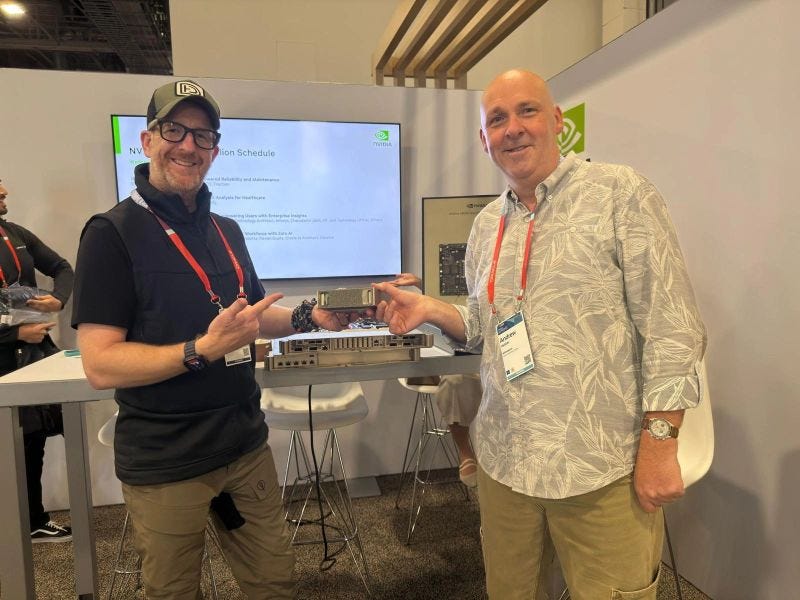
Jensen Huang’s attendance at the UK AI ecosystem celebration alongside Prime Minister Starmer, and the UK government’s £1.1 billion AI hardware plan including sovereign chip investment, provides a policy backdrop that makes deeper NVIDIA engagement in UK sovereign defence increasingly logical.
IMSL
Intelligence Management Support Services, as the first formal delivery partner for the Accelerator, provides the operational infrastructure that early-stage defence technology companies most lack: procurement framework access on a sell-through basis, accredited physical and virtual operating environments, UK security advisory support, bid writing and grant application support, access to cleared personnel and operational team augmentation capability.
This plumbing converts promising technology into deployable defence capability, and it’s the element that most accelerator programmes fail to provide.
A political explosion?
We now move onto speculation.
The evidence here is circumstantial rather than investment thesis. But it would be negligent to ignore it.
The human network surrounding Defence Holdings is almost implausibly well-connected to the current and potential future direction of British defence policy.
Lord Houghton is the former Chief of the Defence Staff and architect of the 2015 Strategic Defence and Security Review. He remains one of the most respected figures in the British defence establishment.
James Norwood sits on NATO’s Coalition of the Willing, shaping NATO-aligned priorities in AI and emerging technologies alongside senior executives from leading defence primes.
Andy McCartney held a one-to-one meeting at 10 Downing Street with Jade Leung, the Prime Minister’s AI Adviser — the person responsible for reshaping how AI is adopted across government and the Ministry of Defence.
Stazicker climbed Everest with Al Carns. That expedition, in May 2025, was a record-breaking rapid-ascent charity effort undertaken by two men with deep military backgrounds. Carns is now potentially the most consequential figure in British defence politics.
Carns resigned as Armed Forces Minister on 11 June 2026, alongside Defence Secretary John Healey, in protest at what he described as an underfunded and outdated Defence Investment Plan.
His resignation statement was a manifesto. He argued, with the credibility of a decorated Royal Marine Commando who served five tours in Afghanistan and was awarded the Military Cross for gallantry, that Britain is unprepared for modern conflict and that the next war will be won by coders, drones and energy independence.
He has since hinted at a Labour leadership bid.
Supporters within the party are urging colleagues to skip a generation and back him as an alternative to a weakened Starmer. Analysts note that his tough stance on national security and modern warfare could neutralise the appeal of Reform UK among the very voters that Labour needs.
If Carns becomes Labour leader — or Prime Minister — the policy environment for sovereign, software-defined, AI-enabled defence capability becomes the central organising principle of British defence investment, articulated by a man whose personal network includes a Non-Executive Director of the exact company best positioned to deliver it.
Even short of that scenario, Carns is now the most prominent and credible voice in British public life making the argument that Defence Holdings exists to address.
Every media appearance, every speech, every interview in which he argues that Britain needs to invest in the software and AI layer of modern warfare is, intentionally or not, making the bull case for this company’s existence and its products.
Meanwhile, the political crisis that forced his resignation has seen the launch of the AI in Defence Taskforce. Project STRONG was direct-awarded. The language deployed was months, not years — the exact phrase that McCartney had been using in Defence Holdings’ own communications.
Whether this represents coordinated messaging, parallel thinking driven by the same SDR doctrine, or something in between is unknowable from the outside.
What is observable is the outcome: a Prime Minister publicly committed to the same delivery model that Defence Holdings has been building, in the same week that the company received its first direct MOD contract.
And that taskforce funding? Some of it, surely, will flow to ALRT.
But why no competitors?
The most common objection to the Defence Holdings’ investment case is this: if the opportunity is so obvious, why isn’t someone bigger doing it already?
It’s a fair question.
The first part of the answer is that some bigger entities are doing it — but not in the UK, and not in a way that is accessible to public market investors.
Palantir is the obvious comparator. Built in the United States, with deep roots in CIA and Pentagon relationships, Palantir has become the dominant provider of AI-powered data analytics and decision support to the US defence and intelligence community.
It is now expanding aggressively into European markets, including the UK, and has been described by senior British officials as effectively indispensable to certain capabilities — even by those who are uncomfortable with that dependency.
But Palantir is American.
And the uncomfortable reality — one that Roughan articulates with characteristic precision — is that in a world of escalating peer competition, the fact that the UK’s most critical AI-enabled defence tools are built on American infrastructure, by an American company, under American legal jurisdiction, is a sovereignty risk that responsible defence planners cannot continue to overlook indefinitely.
The second part of the answer is that the traditional defence primes — BAE Systems, Rolls-Royce, Raytheon UK or QinetiQ — are structurally poorly positioned to address this opportunity.
They are built for hardware-led, decade-spanning procurement programmes. They have cultures, compliance frameworks, and financial models optimised for building ships, aircraft and armoured vehicles over 20 year contracts.
They struggle to move at software speed. They struggle to iterate in weeks. They struggle to attract the software engineering talent that gravitates toward technology companies rather than traditional defence contractors.
The third part of the answer is perhaps the most important: the specific combination that Defence Holdings represents — listed vehicle, sovereign by design, hyperscale partnerships, senior defence relationships, rapid execution capability and an accelerator model that extends the ecosystem — is new.
There is no other publicly listed UK company offering this combination. If you want public market exposure to the sovereign AI defence intersection in the UK, there is only one option.
That is both the opportunity and the risk. The opportunity is obvious, being first-mover advantage in a market that the government has just confirmed is a national priority. The risk is equally obvious - if the execution fails, there is no comparable listed alternative to rotate into.
The accelerator model adds an important dimension to the competitive position. Rather than competing with emerging defence technology companies, Defence Holdings is structuring itself to support them — taking equity positions, providing procurement infrastructure, and connecting them to hyperscale partners — while retaining a platform role across the ecosystem.
This is an offensive ecosystem strategy - one perhaps designed to challenge Palantir in time.
The bottom line
Strip away the detail and the Defence Holdings investment thesis reduces to six propositions:
Global defence spending is structurally rising and will continue to do so for the foreseeable future, driven by geopolitical tensions that show no sign of resolution.
The composition of that spending is shifting decisively from hardware to software, from physical platforms to AI-enabled digital capability, from 20-year procurement cycles to software that iterates every month.
Sovereign control of that capability is a strategic imperative that no Western government can ignore, which means UK-sovereign solutions have a structural advantage over international competitors in the UK defence market.
Defence Holdings is the only publicly listed UK vehicle offering exposure to this intersection of structural growth, spending shift and sovereignty premium. They can acquire a trailblazer valuation premium.
The team is exceptional, the partnerships are real, the government mandate is documented and the first contract has been awarded.
The current stage means the valuation reflects early-stage risk, which means investors with appropriate risk appetite and time horizon are getting in before the institutional re-rating.
If you believe all six propositions — and the evidence assembled in this piece suggests each of them is well-founded — then the conclusion is straightforward.
On 15 June 2026 — the day the Project STRONG contract was scheduled to be signed, the day the Accelerator opened for applications — the Prime Minister of the United Kingdom posted on LinkedIn.
Britain faces a clear choice: shape the AI revolution or let it shape us.
He announced a new Taskforce for AI in Defence, with the authority to cut through the bureaucracy and deliver real operational capability in months, not years.
Months, not years.
The phrase that Andy McCartney had been using in Defence Holdings’ own communications. The phrase embedded in the company’s culture since before most of the investment community had heard of it.
Whether this is coincidence, convergence or something more intentional is a question I cannot answer. What it can say is that the Prime Minister of the United Kingdom has just adopted the operating philosophy of Defence Holdings as national policy.
And they have the first government contract to prove they mean it.
What can be achieved in another year?
Excellent findings and report, genuinly came in late at current price. I will stick it out for the next 5 yrs+
Excellent report Charles.
Thank you