

How to Pick Stocks
Milking Stool Theory

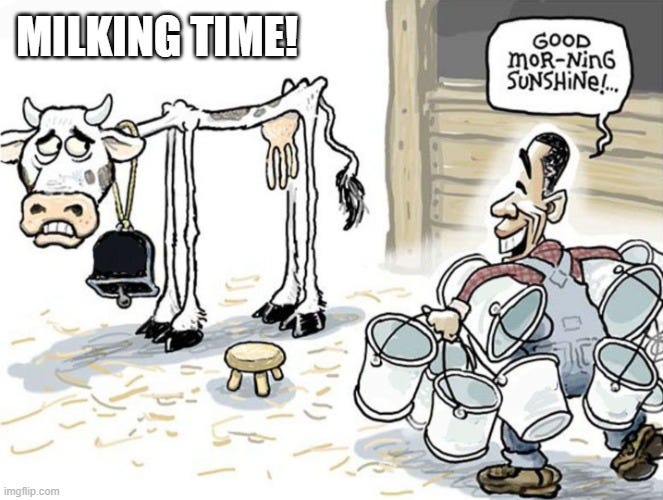
Good Morning Team.
I had a few calls yesterday with various investors asking me to cover a number of new companies, to help shine a spotlight on their investment cases.
My responses varied from a couple of flat NOs, to asking for a chat with management, to one emphatic, and immediate, YES.
Inevitably, the NOs weren’t particularly happy to be told no, so I thought I’d save us all some time and cover my basic philosophy when it comes to backing small caps, regardless of their stage of development.
I’m certain that there’s some official financey language for what I’m about to say, but I’ve always called it Milking Stool Theory.
This works well, because it can be a metaphor for stability and getting milk safely out of a cow, or alternatively for investing in shit.
For those of you not raised on a farm, a milking stool is a three-legged stool, which remains secure on uneven ground - unlike four-legged chairs which rock back and forth. The key idea is that you can milk the cow comfortably because you can lean forward without tipping over.
And for investors, my view is simple: you need all three legs to the stool. If you miss one, you can’t get milk out of the cow.
The cow being your investment.
In fact, if you’re missing one leg, there’s a good chance that you’ll fall forwards and the cow is going to kick you in the chest.
And defecate on your face.
What is Milking Stool Theory?
It’s the three legs of any investment case.
It’s not the only things that matter - but if you’re missing one of the legs, the potential investment is a non-starter.
Leg One: Management Matters
As a general rule, you need three specific kind of people in a management team, or at the very least two people with these three skill-sets.
First, you need someone who has a vision. This is true whether it’s a junior explorer with a drill and a dream - or a growth stock sporting a £500 million market cap.
Second you need someone who can manage the finances properly, and rein in the first chap when they get a tad ambitious. Geologists have a tendency to spend money like water through a high-permeability aquifer - pharma researchers are the same.
These two people balance each other out.
The third person sells the story. This does not mean ramping the stock to the moon, but in the small cap world, you are competing for capital with literally thousands of others.
You need to stand out, and this requires a polished message that cuts through the noise.
Management teams need a decent track record (unless just starting out). This doesn’t mean you rule them out for one or two failures - the most successful entrepreneurs often fail at first - but if they’re 57 years old and never delivered a single success, that might be considered a red flag.
As a long term investor, seeing the stock rise 4x post-IPO, then collapse, then seeing a new IPO once the market has forgotten a couple of years later, is not a good look.
But most importantly (and I’m aware this is where I have an edge as most will take my call), you need to TRUST them.
A big part of this is seeing they have their own skin in the game.
And you need to like them personally.
Small caps are personal.
This is truer the smaller the market cap is.
If you support a company at IPO and they grow to a serious size, the management teams will become something close to friends - similar to Bronn and Tyrion in Game of Thrones. The relationship is clouded by money, but there will definitely be some level of affection.
Life is too short to invest in companies where you wouldn’t share a few pints with the CEO.
If you don’t trust them with a pint, you shouldn’t trust them with your capital either.
Every success I’ve had has come where I’ve liked management on a personal level.
Something to ponder.
Leg Two: Asset Quality
You might think you’ve developed a new technology that solves nuclear fusion. Or found a potential Tier 1 copper deposit in the depths of the African bush. Or perhaps developed an oncology treatment that might become the standard of care for that specific cancer.
Great.
You might have what you claim you do.
You might not.
Now, to be fair, a lot of assessing assets is about comparing the risk-reward profile to the company’s market cap.
If your market cap is £5 million, then the assets don’t have to be particularly developed to be worth a potential investment.
But they do have to hold some promise.
And this can’t be based on marketing fluff. If you’re one of hundreds of exploratory licences in Botswana for example, what specifically makes your licence better than everyone else’s?
Often this comes down to management (for example, this specific geo has enjoyed plenty of success, and they like this particular set of rocks for reasons intuition alone explains).
If your market cap is £100 million+, then your assets need to stand up to growth scrutiny; yes, you might have had successful Phase II clinical trials, but are you capable of delivering a JV with a major? Is what you have good enough to replace the current standard of care? It might be better, but is it better enough on a cost-benefit basis to replace what’s currently available?
Did you have to bring in multiple ‘independent’ persons to get the result you were looking for?
There’s all sorts of questions to ask - but the key point is that whether we’re talking about what’s in the ground, what a treatment might fix, or what a new tech might do - these are the things that cannot be changed.
No amount of marketing will make more tungsten magically appear in a deposit, or make a new treatment work, or solve a tech problem that’s been irritating the general population for a decade or more.
Management can be switched out; cash can be raised.
The asset has to be high quality, or the company is going nowhere.
Leg Three: Capital Management
Does the company have any money?
This is key.
What terms have they raised capital on previously? Do they raise with a bucket shop or an actual broker? Do they have funds and family offices involved? The right HNW names?
Potential investments ideally have capital in the bank, and a prior history of raising capital fairly. Companies list on the public markets to raise money to grow, so this is worth bearing in mind every time a placing is announced.
Now to be fair, the past few years have not been an ideal environment. I get why brokers have insisted on a deep discount, and warrants, and your first born child’s soul - they are effectively held captive by the seven or so cartels of HNWs who offer what terms they choose.
Companies, previously, could either take those terms or get stuffed (unless you’re an Amaroq and place each time at the bid).
But things have changed.
Funds are now interested in small caps in a way they haven’t been for years. They’re the last true bastion of real ‘value,’ and this is particularly true of junior resource companies who already enjoy a JORC resource.
States are also muscling in - brokers now have competition for capital raising, which is a very good thing indeed.
But the point stands: if your last accounts said you had 87p in cash, and you burn £500k a year just to pay salaries and stay listed - then you’re going to need to raise money.
And if your history is one of deep discounts, then it’s hard to say you’re a good investment unless your asset is of outstanding quality (in which case, that discount should not be needed and you need to get yourself a better broker).
I am aware it’s not always this simple, but in general, it’s a hell of a lot more comfortable to invest shortly after (or indeed within) a fundraise, than before an obvious one coming down the track.
Investors have in the main wised up to the Thursday fluffing-up RNS prior to the 6pm Friday placing special.
Companies need to either have a decent amount of cash at hand, or a track record of raising fairly.
OR - a market cap so depressed due to fear of a placing that it becomes fundamental good value regardless.
On a related note, please be aware that companies who raise when they aren’t forced to get better terms than if they wait to the point where they’re running on fumes.
Stop complaining when they do this; it’s in your own best interest.
The Bottom Line
is that investing in small caps is less about finding a sure thing and more about ensuring the stool you’re relying on isn’t missing a leg.
When an investor gets kicked in the face, it’s rarely because of a black swan.
Usually, it’s because they ignored a shaky leg.
They fell for a reasonable asset managed by a serial liar, or they backed a visionary CEO who didn’t have a penny in the bank and no way to raise it without wiping out the cap table.
To recap:
No Management? A ship with no rudder.
No Asset? A rudder but no ship.
No Capital? You’re sinking before you’ve left port.
Of course, you also need the seat. That’s sentiment - but it changes with time. The beauty of the Milking Stool is that while the seat changes with the seasons, the legs are structural.
If the legs are strong, you can wait for a better seat to be bolted on. But if you try to sit on an in-fashion seat that’s attached to a one-legged stool?
You will, inevitably, tip over.
I’ve had my share of bruises from one-legged and two-legged stools in the past. And from stools with three legs, but where one of the legs had been secretly half-sawn through.
But today, if a company comes to me and they’re missing one of these pillars, it’s a flat no — regardless of how shiny the new corporate presentation looks.
Milking Stool Theory.
It simple.
It’s effective.
You need all three legs to get your milk.
My issue is trying to find the info on management. It's like a CV that can't be relied upon. Cash and funding is another area I find difficult. Take the recent BZT fund raiser at low sp value. Total curve ball when revenue is expected in 2026.
I think all 3 legs need to be strong. 2 out of 3 won't give you a stable stool. E.g SCE.