

Asiamet Resources
A deal is coming.


Good Morning Team.
I recently sent an article out on Blencowe recently outlining the asset sale case.
Asiamet is another obvious case for a corporate transaction potentially, coming down the line very shortly.
Here’s why.
Behind Closed Doors: Asiamet’s Strategic Dance - Positioned for a Deal?
WHO MIGHT PAY AND HOW MUCH?
This is, in my view, a corporate inevitability in the making.
Asiamet is a company currently valued at roughly what a Premier League footballer spends on his third yacht, but sitting on what might be the most signposted strategic processes in mining since someone realised Rio Tinto had accidentally bought half of Australia.
The Turnkey Project
Let's start with the basics, because we need to spell this out: Asiamet owns BKM, a copper project in Indonesia that produces exceptional numbers:
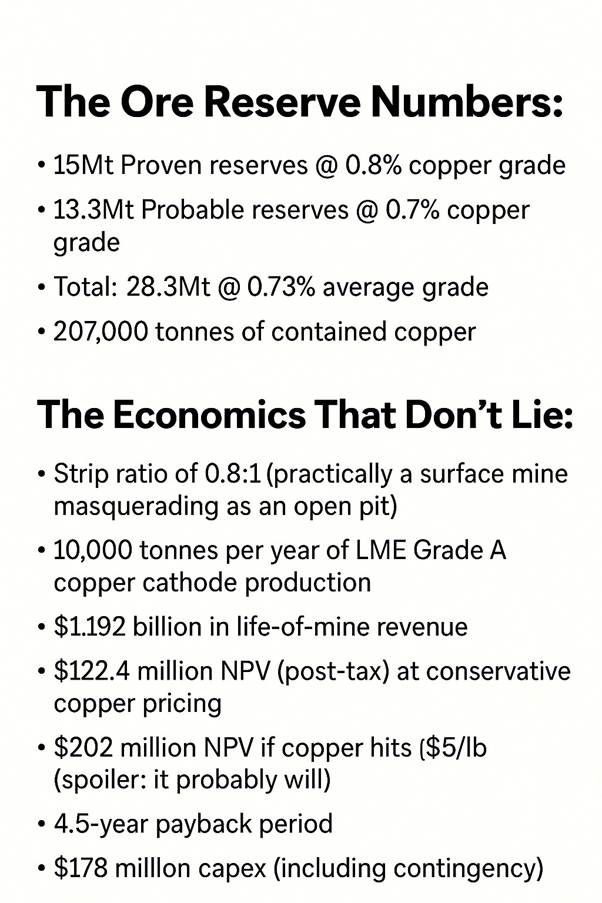
When your market cap is roughly 20% of your conservative NPV and 10% of your upside NPV, something about these numbers suggests the market has collectively decided to ignore basic arithmetic.
For reference, this valuation does not include Beutong or the wider KSK CoW - which may be worth more than BKM!
The Indonesian Advantage (Or: Why Geography is Destiny)
Indonesia isn't just any old jurisdiction — it's the country that looked at China's playbook and said, ‘Hold my Bintang’ (for the uninitiated, that's their rather delicious beer).
They've implemented downstream processing mandates that essentially force miners to add value locally rather than shipping raw materials to China like some colonial tribute system.
Most companies hate this. Most companies aren't sitting on a turnkey copper cathode operation that's gift-wrapped for Indonesian policy makers.
BKM will produce 10,000 tonnes per year of LME Grade A copper cathode. That's not raw ore getting shipped to Guangzhou with a 给你 - that's finished product, ready to plug directly into Indonesia's industrial ambitions.
If you're a strategic buyer looking to tick every possible box with Indonesian regulators, BKM is a geopolitical love letter written in the language of downstream processing and local value addition.
The DOID Situation: 44.6% Shareholder
Speaking of telegraphed moves, let's talk about PT BUMA International Group, our Indonesian investor that recently increased their stake to 44.6% and clearly has both the patience of a saint and the subtlety of a freight train.
What BUMA Actually Owns Now:
44.6% of Asiamet = 44.6% of £30 million market cap = £13,380,000
44.6% of BKM Stage 1 NPV = 44.6% of $122 million = $54.4 million
So BUMA currently owns $54.4 million of NPV for £11.6 million ($14.7 million). That's a 3.7x return on conservative assumptions, before they've even done a thing.
When a native Indonesian company is sitting on a significant paper return and owns nearly half of a project that perfectly aligns with government policy, in a sector experiencing a supply crunch, there are generally two explanations:
They really, really like the management team's coffee, or they're positioning for something much, much bigger.
I'm going to go with option 2, but hey, maybe Indonesian coffee is just that good.
The Perfect Storm of Obvious Signals
Let's count the ways this thing is screaming ‘PAY ATTENTION NOW’ into the corporate ether:
At $178 million, BKM Stage 1 is perfectly sized, not so small that it's irrelevant, but not so large that it requires selling a kidney to finance.
It's the mining equivalent of a starter home in a good neighborhood that everyone knows is about to gentrify.
In August, they appointed Peter Oliver as Project Director. This is a man with 30 years of experience building things in Indonesia, including stints at BHP and other companies that don't mess around.
You don't hire someone like this to update PowerPoint presentations.
You hire them to build mines.
Fast.
In July, they appointed Grant Samuel as their financial adviser for ‘strategic investor engagement.’ For those unfamiliar, Grant Samuel is the investment bank equivalent of bringing a bazooka to a knife fight. They don't do small deals, and they don't work for free.
When Grant Samuel gets involved, it usually signals that significant transactions are being explored.
ARS is currently drilling for limestone 12km from the main project. This might sound boring, but in fact it’s critical. The Definitive Feasibility Study (DFS) assumed the presence of a local limestone source for the processing plant. Confirming this avoids the need to import limestone from across Indonesia — a cost impact that could run into tens of millions — and locks in BKM’s low-cost credentials.
It’s the kind of de-risking step you do when you’re moving from studies towards execution, or demonstrating to potential partners that the project is robust.
The Copper Supply Crisis: When $4.50/lb Looks Cheap
Here's the macro backdrop that makes this whole situation inevitable.
The world is experiencing what experts politely call a ‘copper supply gap’ and what everyone else calls ‘Oh shit, we're running out of copper.’
Global copper inventories sit at multi-year lows while the new project pipeline looks alarmingly empty. The average time to bring new mines online ranges from 7 to 15 years, while BKM could be producing copper cathode in 2 to 3 years.
Meanwhile, electric vehicles need four times more copper than internal combustion engines, renewable energy infrastructure is copper-intensive by definition, and grid modernisation requires massive copper investment.
Currently, copper trades well above $4.50 per pound, but most analysts have 2026-2027 price targets between $5.50-6.50 per pound.
At $5.50 per pound copper, BKM's annual revenue jumps from roughly $100 million to $122 million. That's an extra $22 million per year flowing straight to operating cash flow.
At $6.50 per pound copper, you're looking at annual revenue of $144 million, with operating cash flow potentially exceeding $75 million per year.
For a major mining company, securing 10,000 tonnes per year of copper cathode production in Indonesia isn't just about the current economics, it's about securing a strategic foothold in the world's most mining-friendly jurisdiction during a generational supply crunch.
The real question isn't what BKM is worth at $4.50 per pound copper. It's what it's worth to someone who needs copper exposure and believes the current price is the floor, not the ceiling.
The Timeline of Inevitability
Let's trace the breadcrumbs of corporate destiny:
Early 2025: Study completed, economics confirmed
May 2025: BUMA increases stake, provides funding bridge
June 2025: Formal project financing commences (translation: ‘please form an orderly queue, serious parties’)
July 2025: Grant Samuel appointed (translation: ‘structured process with the region’s top M&A advisers’)
August 2025: Project Director appointed (translation: ‘the build leadership is in place for whoever funds or partners’)
September 2025: Limestone drilling confirms cost optimisation (translation: 'the key input is in place, cost base de-risked')
And then in the same news release, the company drops the three words investors should be shouting from the rooftops: “progressing to plan.”
This is a countdown. If you take nothing else away, take that. Those three words matter more than any assay. That is code for: sit tight, the process is alive and moving. In M&A land, that’s as loud as you’ll ever hear management shout.
The Buyer's Dilemma
Put yourself in the shoes of a potential acquirer. Maybe you're:
A Chinese smelter group looking to secure cathode supply and keep Indonesian regulators happy
A mid-tier miner wanting to bulk up in Asia's most mining-friendly jurisdiction
A commodities trading house with deep pockets and margin to burn
A strategic partner who realises that the market cap and the real value are different things
The question isn't whether you should buy BKM. The question is whether you can afford not to buy it before someone else does.
The Valuation Absurdity
Let’s run the numbers.
BKM Stage 1 shows an NPV of $122.4 million post-tax in the conservative scenario. The current market cap sits at roughly $38 million (£30 million). That’s a 0.31x NPV multiple.
Now, before anyone gets too excited: greenfield copper projects in emerging markets should trade at a discounts to NPV. The question is whether this discount makes sense, or whether it’s overdone.
The bull case starts with the fundamentals:
At 10,000 tonnes per year of copper cathode and $4.50/lb copper, you’re looking at roughly $100 million in annual revenue. Heap leach operations, when they work properly, can generate 40-60% operating margins. If BKM hits the middle of that range at 50%, you’re talking about $50 million in annual operating cash flow once ramped up.
The capex is $178 million with a 4.5-year payback period if construction goes smoothly and the project performs as modeled. That’s a big ‘if,’ but it’s not an unreasonable ‘if’ for a relatively straightforward heap leach operation.
Copper-hungry majors and mid-tiers have been paying 1.5-2.5x NPV for development projects in recent years - though typically for assets in better jurisdictions or with stronger operators. But even at a conservative 1x NPV in a takeout scenario, you’re looking at $122 million, or roughly 3.2x the current market cap.
Every $0.50/lb increase in copper price adds roughly $25-30 million to the NPV. If copper reaches $5.50/lb - which isn’t outlandish given supply constraints and energy transition demand - you’re looking at an NPV approaching $250-280 million.
Now for the reality check:
This doesn’t happen overnight, and it doesn’t happen without risk. You’ve got:
Permitting in Indonesia
$178 million financing to secure
Construction execution in a remote location
A management team that needs to deliver
The market is pricing in these risks. The question is whether it’s overpricing them.
At current prices around 1p per share, you’re essentially betting that management can execute a reasonably straightforward heap leach project in a copper market that desperately needs new supply. If they can navigate Indonesian bureaucracy, secure financing on reasonable terms, and hit their metallurgical targets, the upside is substantial - potentially 3-5x from here in a takeout scenario, or more if they build it themselves and copper cooperates.
That’s the kind of risk/reward that makes sense for a small position in a speculative portfolio - but only if you can stomach the volatility and timeline uncertainty that comes with greenfield development in frontier markets.
The Final Countdown
Not so long ago, CEO Darryn McClelland noted that they're ‘preparing to open a data room and expect to begin formal engagement with project finance lenders shortly.’
In corporate speak, this translates to: 'The technical work is largely complete, and the project is ready for formal engagement with financiers and strategic partners.'
The company has been talking to funders for years, but the difference now is that the project has been remodelled into a straightforward, lower-capex starter mine, exactly the kind of shape that makes both financiers and potential partners engage.
With the technical work complete, the boxes funders asked to see are ticked, and financing and strategic processes are now running in parallel.
The Bottom Line
Sometimes the market serves up opportunities. A development-ready copper project, in a mining-friendly jurisdiction, perfectly aligned with government policy, owned by competent management and a strategic Indonesian partner, trading at a fraction of its NPV during a copper supply crisis.
Management incentives in place.
The smart money isn’t asking if Asiamet ever attracts a partner or acquirer — they’re asking on what terms, and at what valuation, relative to today’s disconnect.
How do you rate this vs Jubilee? JLP now producing already, seemingly with sale proceeds coming through to keep investing in expanding existing processing facilities (Roan and Sable)? Obviously mkt cap quite different but almost like one has spent the set up costs already (or most of it).
I’d be worried about political risk, I remember Churchill Mining from many years ago, think they had their project stolen by corruption in Indonesia (from memory). Ruined that share. I’m sure only reason Mankayan project in Philippines (with superior NPV) hasn’t been developed sooner, is down to political risk. I realise it is now being progressed by Blackstone!. I maybe totally wrong - just don’t underestimate corruption threat.