

Picks of 2026
Can we deliver another 100% this year?


Good Morning Team.
A couple of weeks ago, I tallied up my average return across my picks of 2025 - ending up with a mean of 78.5%.
Happily, a heady cocktail of low Christmas period liquidity and squeezing metals saw the portfolio crack 100% just in time to ring in the New Year.
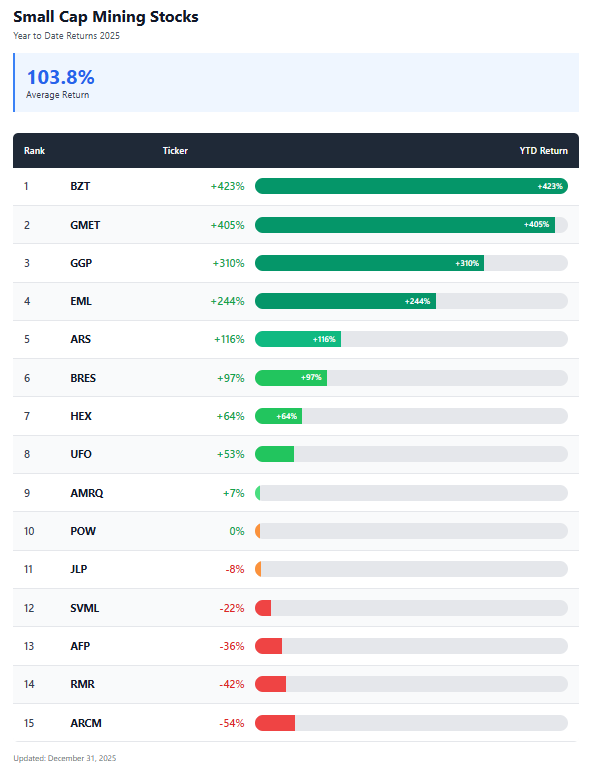
It’s actually closer to 110% as of today, but who’s counting?
As I noted a couple of weeks ago, these are not ‘real’ share prices - if the gains hold next week, then sure - but a lot of it is just market maker shenanigans.
Still, it’s a good day to be Charles.
I would like to thank the many, many people who (whether selflessly or in their own interest),brought me face to face with management teams at promising companies to really get into investment cases.
As ever, if there is a high quality company out there that you think deserves coverage, whether written, audio or both - get in touch.
I’m easy to find.
Before we begin, a caveat. I have a strong risk appetite and invest long-term in risk plays. These are not for everyone and there’s no shame in this.
This Substack is not for everyone.
Further, nothing here was, is or ever shall be financial advice. My portfolio would give the average IFA an anxiety attack.
But bottom line, a new game starts now.
Naturally, the first question is this: Can I deliver another 100% year in 2026?
The answer is almost certainly no.
But we’ll give it a go.
Shocking right?
I know there are many Twitter traders generating a 100% return on seven figure portfolios in the time it takes to boil their Le Creuset kettle, but here in the real world, the aim of the active investor is to beat index funds.
That’s it.
With the AI bubble still on the verge of implosion, the Middle East and Taiwan flaring up again, tariff problems, bond market chaos and oil crashing - navigating the market next year is not going to be easy.
The truth is that politics is moving metal as much as traditional dynamics, and this makes predictions harder.
On the other hand, with metals at record highs and most juniors - or even majors - yet to move enough to account for their new profit margins, we might be at the very start of a generational bull run that makes the juniors look like memecoins.
We shall, no doubt, see.
What I am certain of is that resource stocks are nowhere near where they should be given the price of oil (usually the single most important component of AISC) and the prices of most critical and precious metals.
Either oil recovers, metals fall, or share prices rise.
Something’s got to give, and with money as in nature, what moves is that which is easiest.
Pretty much every major analyst expects oil to stay depressed or even fall further in 2026. I’ll cover why another day (and I’m not convinced they’re right), but it is what it is.
It’s worth noting that this low oil, high metal situation is most definitely not normal - and anybody who tells you with certainty what comes next is lying.
Textbook economics (I refer to this a lot) might suggest that oil and copper should trade together as both depend on demand dynamics. Or that gold and silver work as a pair. Or that gold and oil prices should have something in common.
Something is broken.
And I can’t see metal prices coming down (okay, a bit from the recent spike), but the game has fundamentally changed.
That leaves share prices rising.
If you’re a gold/copper/silver etc producer sitting on chunky margins and making more money than you ever could have dreamed of - then make hay while the sun shines.
If you’re an explorer with a rocketing share price on a decent set of assays, then placing a few shares for a rainy day when the brokers are throwing capital at you (which was certainly not the case last year) is no bad idea.
I remember during the pandemic days telling any CEO who would listen to shore up the balance sheet with minimal dilution in the good times. Those who listened had a much better time of it through the bear market.
Mining is cyclical, squirreling away a few nuts for the winter makes good sense, especially when the tree is groaning and the squirrels are still getting fat.
This year, while my focus will remain on junior resource, I will be expanding this newsletter to cover some growth stocks and a smattering of moonshots that may end up fated as either Apollo 1 or 11.
I’ll also be adding to picks as the year goes on; there are some companies I would like to name now but I’ve simply not had the time to research them in great enough depth to be confident to invest.
I do try to be comprehensive; and I can only hold through the kind of volatility we come up against if I am confident in the investment case’s risk-reward profile.
Let’s dive in.
Advance notice
Having just said I like to comprehensive, I’m not going to be comprehensive here as each stock on this list will enjoy its own deep dive at some point in Q1. Please bear with me, as there’s a limit to what I can achieve.
Speaking of which, I’m planning to introduce a £10 a month optional subscription at the start of Q2 2026 (1 April).
This will help me commit more time to writing here, to bring you my perspectives on not just UK small caps, but global opportunities.
Some of my biggest wins over the past few years have never made it to public eyes, simply due to time constraints.
But it’s more than that - it’s wanting to be able to allocate time to share my opinions on what’s going on in the investing world without the constraints of a compliance department or branding team.
Plenty of small cap articles and interviews will remain ‘free,’ but the deeper analysis and more frequent content will be available to subscribers. I want to create a sustainable model that allows me to dedicate proper time to the research and writing that I know many of you value.
I don’t do things by halves. A subscription tier means I can justify the hours spent digging through financials, following leads across different markets, and crafting comprehensive analysis that helps investors make better decisions.
That’s the idea anyway.
Stocks of 2026
I’m going to split picks into three sections this year: growth stocks, junior resource and moonshots.
As with last year, I’ll be reviewing key updates at the start of each month.
And as I said, expanded DD for each is on its way.
Growth Stocks
The idea with these US growth picks is not to hold them for the full year - they’re trades, not conviction investments.
I’ll let you know which Ill keep holding onto at each update - but I’m confident that as a portfolio, they’ll deliver a positive return.
However, like the small caps, be aware that these are generally HIGH RISK investments.
PayPal
This one’s easy to explain (mostly because everyone knows what it is).
It’s at a huge share price low and sentiment has collapsed to the point where it’s possibly the most hated stock on the market.
But if you set aside investor fatigue, its got an incredible fundamentals set-up.
The key point to understand is that it’s a cannibal stock. PYPL is buying back its own shares at a rapid rate - and has $20 billion authorised for more buybacks. The balance sheet is strong and there is no real danger at this share price point (barring a black swan).
We could see it repurchase more than a third of its market cap over time.
Sure, not really a growth stock given the $54 billion market cap - but it feels that way.
UiPath
Imagine you work in an office where you have to do the same tasks every day: copy information from emails into a spreadsheet, then check three different systems to verify the data, then send a confirmation email.
It takes 30 minutes and you do it 20 times a day. That’s 10 hours a week of repetition, that is both boring and costly.
UiPath makes software robots that watch what you do on your computer, learn the pattern, and then do it for you automatically.
These aren’t physical robots - they’re programs that can click buttons, type into forms, read screens and move data between systems just like a human would, but much faster and without ever getting tired or making mistakes. (In theory).
The company started with simple automation - recording macros on steroids - but now they’re adding AI to make the robots smarter.
Instead of just following rigid rules (for example, always click this button, then type this), the new AI-powered version can actually ‘understand’ what it’s looking at and make decisions.
So if an invoice comes in a slightly different format than usual, the robot can figure it out instead of breaking down like Bandit from Bluey and asking for help.
For businesses, this is hugely valuable because they can automate thousands of repetitive tasks without having to rebuild all their old software systems. The robots just work on top of whatever programs are already there. A bank might use UiPath to process loan applications, a hospital to handle insurance claims or a retailer to manage inventory updates.
As AI gets better, these automation tools become the glue that connects AI capabilities to actual business processes.
Every management team wants to use AI, but UiPath gives them a reason to use it that isn’t based solely on looking up-to-date with tech developments.
Figma
Now imagine you’re designing a mobile app. Traditionally, this was a nightmare - one person makes the design in Photoshop, emails it around, someone else makes changes, version conflicts happen, nobody knows which file is the latest, and actually turning those designs into working code is a separate headache.
I’ve been there before.
Figma solved this by moving the entire design process into your web browser. It’s basically like Google Docs, but for designing digital products. Multiple people can work on the same design at the exact same time - you can literally see your teammate’s cursor moving around the screen as they work.
Designers, developers, product managers and marketers can all collaborate in one place, leave comments, suggest changes and instantly see updates.
What makes Figma special is how it became the standard tool that connects designers and developers. Instead of designers throwing mockups over the wall to developers who then have to rebuild everything from scratch, Figma lets developers inspect the designs, grab the exact colours and spacing measurements and even export code snippets.
It dramatically speeds up the process of going from idea to finished product.
Now they’re adding AI features that can do things like generate design variations, suggest layouts or automate repetitive design tasks - basically making designers more productive while still keeping the human creativity (for now at least).
Figma has become the industry standard tool, and companies that start using it tend to expand usage across more teams and pay more over time. And it’s already profitable while still growing fast.
The stock crashed after its IPO hype wore off, which may make it more attractive now - you’re getting a market-leading software company at a reasonable price, and I think the fall is overdone.
Procept BioRobotics
As men age, their prostate gland often enlarges - a condition called benign prostatic hyperplasia (BPH) that affects millions of men. It causes frustrating urinary problems including difficulty urinating, frequent bathroom trips at night and incomplete bladder emptying.
It’s not life-threatening, but it seriously impacts your quality of life. And it’s very common, with some experts arguing that more than 50% of men are impacted to some degree after the age of 60.
It’s inevitable that many of you reading this suffer from it.
The bad news is that traditional surgical fixes have tradeoffs. Some procedures work well but cause sexual side effects that men understandably want to avoid. Others are gentler but less effective. Doctors have been stuck choosing between effective but risky, or safer but mediocre, for decades.
Procept created a robotic system called Aquablation that uses a high-pressure water jet guided by ultrasound imaging and AI to precisely remove excess prostate tissue. You can think of it like a robotic pressure washer with surgical precision - the robot maps out exactly what tissue needs removing, then executes the procedure with superhuman accuracy.
The key advantage is that it’s both highly effective at relieving symptoms and has a much better side effect profile, particularly for preserving sexual function.
Over 52,000 procedures were performed this year, meaning urologists are actually starting to choose this over traditional methods. I suspect it will become standard of care. Insurance covers it, hospitals are buying the systems, and patient outcomes are strong.
The really exciting part is the ongoing prostate cancer potential. If trials show Aquablation can effectively treat localised prostate cancer (which is sadly also quite common, but much serious than BPH), the addressable market explodes.
Prostate cancer is one of the most common cancers in men, and a robotic treatment that’s precise enough to remove cancerous tissue while sparing healthy structures could be transformative.
The stock trades like an unproven startup when it’s actually a rapidly scaling company with proven technology, growing revenue, expanding adoption and a massive potential catalyst on the horizon.
Kraken Robotics
Think about trying to find something on the ocean floor - a sunken ship, an underwater pipeline that needs inspection or sea mines that need to be cleared. The ocean is pitch black below a certain depth, incredibly vast and humans can’t go down there easily.
Kraken makes high-tech sensors that go on underwater drones and submarines - specifically sonar systems that can see underwater with incredible detail. Think of it like giving underwater robots ultra-high-definition vision in complete darkness.
Their technology can create 3D images of the seafloor that are so detailed you can identify small objects, map underwater terrain or spot anomalies that need investigation.
The company also makes complete underwater robotic systems and provides services where they’ll actually go out and do the underwater surveying for you. Their main customers are navies (looking for mines, mapping seafloors for submarine operations or protecting ports), offshore energy companies (inspecting pipelines and underwater infrastructure), and ocean research organisations.
Underwater activity is exploding - more offshore wind farms need to be built and maintained, navies are investing heavily in underwater defense as submarine warfare becomes more important, and there’s growing interest in deep-sea mining and exploration.
Kraken has carved out a niche with superior technology, and as a smaller company, even modest market share gains in these growing sectors could drive significant revenue growth.
Xenon Pharmaceuticals
Assume for a moment that your brain’s electrical system occasionally short-circuits, causing seizures. For epilepsy patients, this can happen multiple times a day.
About a third of epilepsy patients don’t respond well to current drugs, leaving them with no options and a hugely impaired quality of life.
Xenon has developed a drug candidate that works differently than existing epilepsy medications. It targets specific sodium channels in the brain - essentially, the circuit breakers of your electrical system.
Their drug, azetukalner, is designed to prevent the abnormal electrical firing that causes seizures, but in a more selective way that might mean fewer side effects than older medications.
The drug has shown promising results in clinical trials for several hard-to-treat forms of epilepsy. If approved, it could actually help patients who’ve run out of options with current treatments.
This is classic biotech territory: if azetukalner gets FDA approval and succeeds commercially, Xenon’s value could multiply dramatically. The epilepsy drug market is large (billions of dollars), and a genuinely better treatment option commands premium pricing.
The company also has a partnership with Neurocrine Biosciences, which provides institutional validation and resources. The risk is also classic biotech - clinical trials could fail, regulatory approval might not come through, or the drug might not sell well even if approved.
Target
Target is the US retailer - the place where you go in for toothpaste and come out with $200 worth of shit you either didn’t need or didn’t know you needed.
It’s basically a more upscale, design-focused version of Walmart, positioned in that sweet spot between discount stores and department stores.
What makes Target interesting as an investment now is that it’s had a truly awful couple of years. The stock got hammered as the company dealt with excess inventory after the pandemic buying surge, squeezed profit margins from inflation and theft, and softer sales as consumers pulled back on discretionary spending.
It also got caught up in the anti-WOKE culture war.
But this is precisely why it might be an opportunity. Target has strong fundamentals that haven’t disappeared - excellent store locations, a known brand (especially with younger, more affluent shoppers), a well-integrated online and in-store experience and exclusive designer collaborations that drive traffic.
A turnaround play, then, on a quality retailer trading at depressed valuations. When consumer spending stabilises and Target gets its operations back on track, the stock could re-rate significantly higher.
You’re betting that the challenges are temporary and fixable, not permanent - and it has decades of track record as a survivor in the cutthroat retail industry.
Junior Resource
Before we run down individual picks, a prediction: uranium will be the best performing hard commodity of 2026.
The technical and fundamental set-up is beautiful. I’m actively looking for more small cap opportunities but just investing in Yellow Cake is a good start.
Again, comprehensive investment cases for these stocks are either in the archive or on the way.
Now for the picks of ‘26:
Conviction Plays
We’re retaining Amaroq and Sovereign Metals for 2026, for the same reasons as in 2025. Amaroq will corner Greenland, is going to start spitting out gold at a rate that puts its market cap to shame, may have a Tier 1 discovery on their hands in Nanoq - and will almost certainly attract government cheese this year.
Sovereign has the World Bank’s backing for the largest rutile and second-largest graphite deposit in the world. The bankable feasibility study and MRE upgrade are hitting this quarter and the re-rate closer to fair valuation is coming.
However, Greatland is out - simply because it can’t really be classified as a ‘junior resource’ stock anymore. Sprott likes to define juniors as sporting a market cap lower than $2 billion - and we’re well past that now.
As one of my larger holdings, I will cover any major news that breaks in one-off articles, but in my mind, the transition from junior to producer is over.
We won. It’s moved into a different league - out of the world of newsletter writers and into one of major outlets.
This is the happy ending.
I’m also happy to field any questions on GGP at any time; and continue to hold for £6.
This year, I’d like to add in GreenX, which I’ve covered a few times before - the legal case and Nazi copper are strong reasons to invest. A comprehensive article is coming soon.
I will caveat that until the legal case is finalised, I will keep this investment portfolio % limited - I think the case is a foregone conclusion, but binary events can be unforgiving.
Buyout plays
We’re keeping Helix, Asiamet, Guardian and Blencowe in the mix - not as dealmakers, but as buyout stocks.
All have been on a run in 2025, but for different reasons I’m hoping for payoffs at a premium.
Helix is simple - the helium cartel will not tolerate a producer messing around with pricing.
Asiamet’s deal for BKM has already been agreed - and I suspect Beutong is around the corner. Sell everything, get 3p a share and retain the shell.
Blencowe has its DFS, so it’s simply a case of either building this thing (or selling). I’m 50:50 on where that lands, but a sale at some point seems very possible.
Afentra is a new pick - the assets are simply worth a lot more than the market cap and my guess is that either it has to re-rate, or somebody is going to put in a bid in 2026. I can’t say as to what would be accepted, but either way a decent rise is in the offing.
Fundamental plays
Power Metal, African Pioneer and Jubilee Metals remain on the list, and all for the same reason.
Fundamentally, their assets/cash are worth far more than their market caps. POW and JLP are cash rich, so the chances of a painful placing are basically zero - and while AFP is cash-light, its £2.5 million market cap is a huge undervaluation.
I suppose though that I’ve had the belief these would re-rate for two years now - perhaps third time’s the charm.
Long term investing takes time.
Produce & Expand
Xtract Resources is hopefully going to produce this year, possibly from two sites (antimony in Morocco and copper-silver at Silverking), and it’s going to expand with the fruits of the production. Having got a placing away, we’re in a nice spot to start the year.
Switch Metals is in the tantalum game. Having signed an MoU with Xcelsior Capital Advisors and commissioned its pilot wash plant at Issia, we’re looking to a maiden MRE very shortly - these are some of the best tantalum licences you’ll find anywhere and is one of few ways to play the mineral. I view Switch as a potential 10x over the next few years if all goes well.
Alien Metals has cash in the bank, joint ventures for at the iconic Elizabeth Hill silver mine and another for PGMs at Munni Munni.
As incestuous as the Lannisters? Absolutely.
But with iron ore pricing back on track, at some point Hancock too will be monetised, and we should see consistent newsflow with all metals involved racing.
Bezant will (caveats as always) produce copper this year, and then plow the profits into expanding the Hope & Gorob resource into a significant Tier 2 asset. I’ve crunched the numbers on this; it should have further to run.
Arbitration plays
GreenX has an exceptionally strong arbitration result to deliver, and Emmerson remains in my portfolio though I have taken some profits.
Where to put those profits?
Zenith, which in my view may have one of the strongest potential arbitration outcomes compared to its market cap.
The assets (particularly the Italian uranium) are also attractive - and if I’m right about both the legals and the uranium boom, this depressed share price could be a big winner.
Exploration games
Rome Resources remains on the roster. Alphamin’s Bisie is going to run out of metal int he next few years and they’re going to want to buy more. There’s a resource with $1 billion of in situ metal now (yes what’s actually extractable will be less), but Rome is only going to deliver more…and Alphamin will want to snap it up in time. IRH just acts with the urgency of an Ent.
Ajax Resources is a newcomer to my explorers. A comprehensive write-up is coming soon, but I know the Eureka project well and it’s this I care about most. A young, engaged CEO along the lines of Oliver and Eldur surely can’t hurt either. Stay tuned.
Arc Minerals again stays. The share price fall basically means a court win will see a huge jump - and the company has cash on the balance sheet. These remain some of the best licences in Zambia and when the dust settles the entry here looks solid.
Moonshots
I’ll be honest.
I love moonshots, perhaps more than any other type of stock. They’re exciting. They’re fun.
They might deliver a 10x in a year if they deliver.
But they’re also binary. Success means shareholders make a fortune, but risk cuts both ways. These stocks deserve an investment (imho) but it’s important to consider your risk appetite and portfolio balance.
We’ll start with AFC Energy. This could be the turnaround play of 2026, with multiple shots on the hydrogen goal. I have faith in management and am certain we will see big things this year.
Defence Holdings comes next. Put aside the technicals and this is a binary bet on Andy delivering tech products that will sell and scale. Like AFC’s a bet on John, Defence is really a bet on Andy. And he’s the real deal.
Solvonis and Immupharma are my two biotech moonshots for 2026. These companies would already be worth 5x simply by being listed in New York - and I’ve done the technical dd on both. 2026 is the year for both to deliver value realisation. Just keep an eye out.
United Oil & Gas is going to deliver results from its piston coring survey off Jamaica this quarter. Success could well see a $50 million JV come through - and then we’re off to the races.
Finally, Stallion Uranium. Long-term readers will know I invested in this before the share price takeoff, but basically, if their new approach works as expected, they’ll be able to identify Tier 1 assets in the Athabasca (the world’s No1 uranium address) with ease.
Seems like a good call for the uranium bull market.
The Bottom Line
I’ll go into excruciating detail on all these and more through 2026 as you’ve come to expect.
But the key thing for me is this: I’m continuing to back close to the same stocks in 2026 as I did in 2025. The ‘losers’ will recover; the winners are being allowed to run.
There are a few new names here, all with promise, and a few more joiners to come.
Going into 2026, you’ll see significantly more output - including more content on the macro - alongside more commentary on US stocks which come with their own advantages and challenges.
Here’s to a great 2026!
Looking forward to seeing more excellent research and interesting ideas for 2026. The subscription will be well worth it in my opinion.
Got round to reading this piece over the weekend , thanks for some excellent ideas and research . I have a different approach to you in that I only ever own 5 or 6 stocks that i have total belief in , so many of your names are too small and speculative for me. However , I do agree with most of your main themes although the stocks I have chosen sometimes differ … slp ( platinum ) , hoc (silver) and yca
( uranium ). I also own ftc ( go Elon ) and boom ( pods are the future).
Hard to say which I’m most excited about but like you I believe uranium may well be the star commodity this year.
Thanks again for your hard work.