

Easter Sunday Special
The Case For Growth

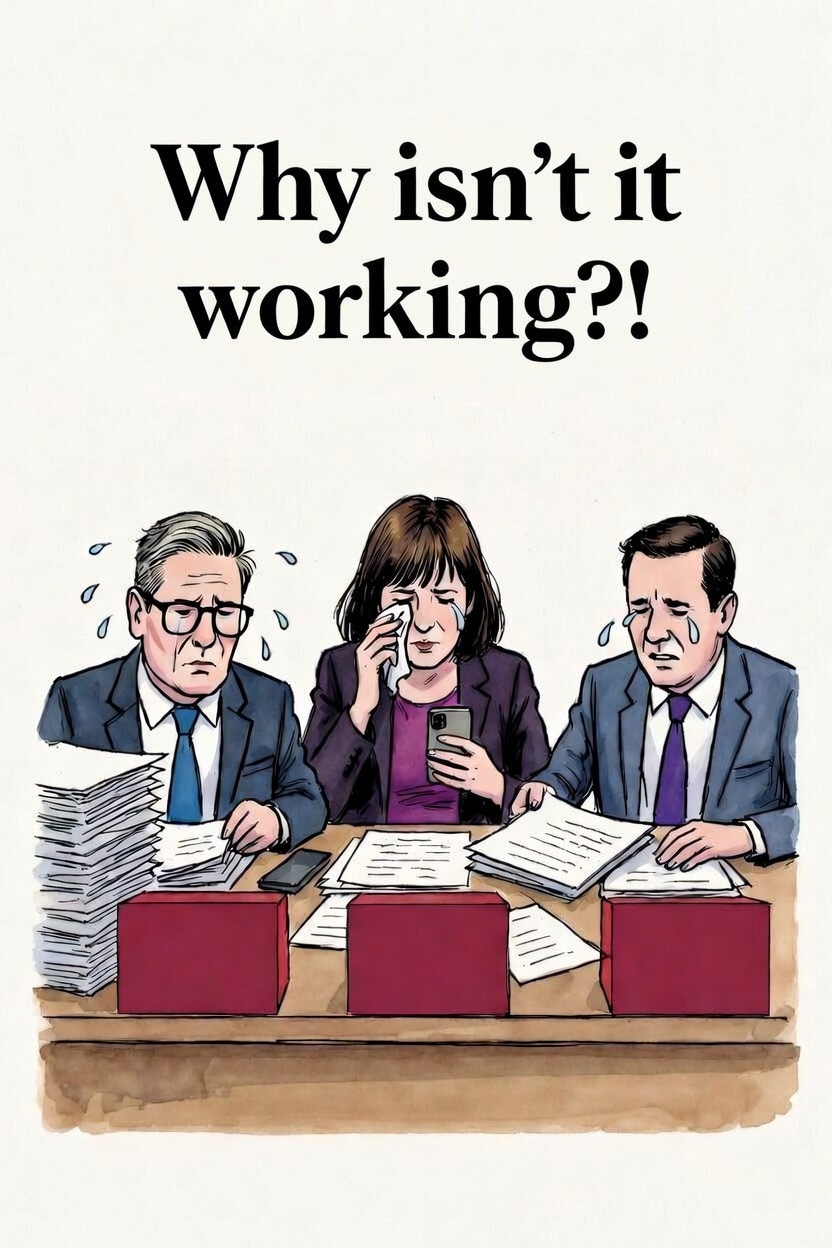
‘I don’t understand it’ cries Rach.
Not for the first time in her life.
‘Why isn’t there any growth? We’ve tried EVERYTHING!’
Keir looks up at her sadly.
‘I blame the Romans. And the Normans. The last government. Nigel. And Zack too.’
Torsten interjects: ‘But Reform and the Greens haven’t even had a turn yet.’
Oh my god thinks Keir. I just had an actual opinion. And I said it out loud, like I have a spine.
QUICK - RETRACT.
‘You’re right Tor. I was just being silly.’
He looks at Rachel.
Rachel looks at her calculator.
There’s a weird symbol on it.
‘What’s this thing mean? The one where the two lines meet like a cross?’
Torsten glances over.
‘That’s the plus sign. It means when you add something together.’
Rach thinks on that for a moment. She doesn’t understand, because she is neither a qualified economist nor has much by way of relevant experience.
But she remembers something.
‘Like the opposite of the minus sign?’
She remembers that one from when she fiddled expenses at HBOS.
Keir looks at her quizzically.
‘What’s that?’ Rach spies something out of the corner of her eye.
‘You’re online clothes shopping again! Oh Keir, you said you would pay attention this time!’
The PM grimaces. ‘I’m not really shopping Rach. You know my Sugar Daddy buys all this for me. All I have to do is…’
He thinks of his rent boys.
Thank god another war started.
That was dangerous territory.
‘Shall I call Diane?’ Tor interjects.
‘Her maths always works out. Somehow, we always get the answer we’re looking for!’
‘NO’ shout the other two aggressively.
As dumb as they are, even they know there is no mathematical problem to which the solution is Abbott's abacus.
‘Let’s go through this again’ suggests Tor.
Right.
‘We’ve made them file their tax returns every three months.’
‘Apparently that just adds accounting costs, and doesn’t actually make businesses any more money’ replies Rach.
Hmmm.
‘Well, let’s ask someone who’s run a small business why there isn’t any growth?’ urges Keir.
Who can we ask, they think.
Silence.
They don’t know anybody who’s run a small business.
Even though they comprise virtually all businesses in the UK and employ 60% of the private sector.
At the mention of the private sector, Torsten spits.
‘PRIVATE SECTOR?!! PROFITS! CAPITALISM!!!
FUCKING ANIMALS!!!’
Torsten isn’t a fan of business. His soliloquy is long but he eventually calms down.
‘Okay then, let’s just think this through.’ soothes Keir.
Thinking is in short supply in this government.
‘Okay, I’ve got it!’ screams Rach.
‘We need more public sector workers!’
‘Ah no,’ explains Torsten. ‘We’ve actually continued to hire more and more public sector workers but it actually hasn’t generated any growth at all. It turns out that public sector workers are primarily for societal good and not economic growth. Everything they’re paid comes out of profits taxed from the private sector, or borrowing.’
‘So’ says Keir, ‘We need more workers in the private sector.’
They think for a moment.
And then they think some more.
There’s only three men who could possibly help.
Only three that really understand how to grow the private sector.
Men with real experience.
The Devil himself, the AntiChrist and Stuart.
Rachel picks up the phone, tapping in the numbers gingerly.
Ring ring. Ring ring.
‘Yes’ chisels a gruff Irish voice.
‘Um, Hi Michael.’
The three chime together: ‘We were wondering if you could help us grow the private sector.’
They hear the Irish smile before the response comes.
‘Feck Off.’
The phone goes dead.
Onto man number two.
Ring ring.
‘Yeah’
‘Hi Tim. We were just wondering, if, well, maybe, you could help us with our growth problem?’
They hear a long, deep slurp of Abbot Ale.
‘I’d love to help!’
‘Really?’
‘Yeah! Resign.’
The call ends. The three start sweating.
They know what call they have to make.
This isn’t just any call.
This is an M&S call.
Ring ring. Ring ring.
‘Stuart!’
Stuart has actually done manual labour. He’ll know what to do.
‘Stuart, please help. We aren’t important enough to call Tufan. We need to know how to grow the private sector.’
Stuart sighs.
Stuart knows this is pointless.
But someone has to try.
‘Have you tried getting the police to do their jobs properly? Kind of hard to run a shop when every other pack of Percy Pigs is professionally pilfered?’
Keir is indignant.
‘Don’t be ridiculous Stuart. You know we can’t enforce basic law and order. The ECHR forbids it!’
Stuart inhales deeply. If he vapes, he would do so now.
‘To grow the private sector, you need lots of new businesses being started. New businesses create jobs, which grows private employment, which in turn drives further economic expansion.’
Rachel and Keir glance at each other.
That’s a lot of big words.
Torsten knows some of them though. They were in his theory textbook at the Resolution Foundation. He’s never seen them put into practice, but is pretty confident this might be treason.
‘Okay,’ says Keir. ‘We pass a law saying workers must start a new business.’
Rach smiles at him. It’s all going to be okay.
Tor is looking daggers.
Then Stuart interjects.
‘You can’t legislate for this. You need people to choose to start new businesses.’
This is another anathema to Keir.
His head is starting to hurt.
‘But my father was a toolmaker,’ he cries.
Stuart pauses. He’d almost feel sorry for the trio. But this is no time for mercy.
‘Why do you suppose people want to start businesses?’
He asks gently this time, knowing the moment is fleeting. Professional psychiatrists might classify this as a breakthrough.
Our glorious leaders are stunned by the question.
‘To contribute more tax to HMRC?’ Rach ventures hopefully.
Stuart laughs for the first time. But mirthlessly. Like a man who has just learnt that stupidity, is, in fact, infinite.
The call ends abruptly.
The three think some more.
‘Let’s pretend we’re in a QUANGO’ suggests Torsten.
The others look relieved, and immediately agree.
PAPER TITLE: WHY START A BUSINESS?
Torsten starts.
‘We know two out of three small businesses fail in the first five to ten years. So let’s just assume our new small business is the lucky one that survives.’
Rach has an original thought. It’s her first one ever!
‘But it can’t just be one of the ones that survive. We know lots of businesses only ever make minimum wage for the owner. And lots of owners are working for less than minimum wage as well!’
They agree; it has to be one where the founder makes a decent amount of money.
They settle on £100k a year. That’s practically a millionaire.
‘Okay’ says Torsten. ‘Let’s model this.’
‘Hang on’ says Keir, ‘Remember, this needs to be £100k in profit, not revenue. If it’s a pub, profit margins are tiny. They probably actually need to sell £1 million of beer to make £100k!’
Torsten laughs.
‘Oh those private sector fools! Just get free money from the government!’
Keir thinks about his special magic pension, and decides not to pursue the point.
‘OK’ says Rach. ‘£100k profit. It’s nearly three times the average income outside of London and four times minimum wage. It’s also a nice round number, and we don’t have think about the massive tax trap that comes after.’
That won’t mater soon because MP salaries will get hit shortly and they’ll fix it.
They think again for a moment.
‘Okay, we need to do some maths’ suggests Tor.
‘Let’s use a recent Master’s grad’ says Keir. ‘They’re fucked by the coming recession and AI destroying their chances, and of course, the complete oversaturation of graduates.’
‘Perfect’ says Tor.
‘Okay’ says Keir. ‘Let’s say they save £20k and don’t put it in their ISA. They could get an almost guaranteed and basically risk free, tax free 7% annual return for life, but they want to break free from the rat race. And start a limited company.’
‘What if they want to buy a house?' questions Rach.
There’s a short pause.
All three burst into uncontrollable laughter. Five minutes later, tears streaming down their faces and still chortling, they return to the matter at hand.
‘Okay, let’s model this.’
‘Our grad will pay himself a £12,570 salary right? And then the rest in dividends?’ says Rach.
‘But a higher salary reduces the corporation tax due. And increases the corporation tax relief? Maybe this isn’t the most efficient way anymore?’
Nobody says this, because it’s a bit complex to think about. It might be true. It might not.
So they decide to go down the easy route.
‘100,000 minus 12,570 is 87430’ smiles Rach.
I did it Tor! I used the minus sign!
‘Well done’ beams Torsten.
Brilliant.
‘So, they’ve got £12,570 completely for free’ he thinks to himself privately.
‘So,’ says Keir, ‘let’s assume we’re taxing that £87,430. To start with, don’t they get the first £5,000 tax free?’
‘Ah no, sorry’ says Rach.
The other two stare at her.
‘That’s £500 now. It was £5,000 a decade ago but you see, the last government…’
‘OF COURSE!’ reassures Keir.
Everything’s the last government’s fault.
‘Okay then, well, we can assume this chaps’ company had to generate maybe £130,000 or so to cover the corporation tax before salary and dividends first?’
‘That seems about right’ says Tor happily. ‘It got whacked up from 19% to a sliding scale going up to 25% a couple of years ago, remember?’
Oh yeah, I remember. That scale goes up to 26.5% actually. It gets complicated.
‘Then how much are the dividends taxed then?’ asks Keir.
Tor responds: ‘Well…income up to £50,270, the dividends are taxed at 7.5%…’
But he’s cut off by Rach.
‘Sorry Tor, but remember the Health and Social Care Levy? We got rid of it for National Insurance. Then employee National Insurance got cut two more times. But we kept it for dividends, because fuck small business, that’s why.’
‘Right you are Rach - OK then, as I was saying, up to £50,270, 8.75%. That sounds generous’
Rach smiles. ‘Don’t worry Tor. It’s going up again. Remember? Another 2% rise to 10.75%? And that slice between £50,270 and £100,000? Going from 33.75% to 35.75%.’
Much better.
Can’t let anyone generate any personal wealth by mistake.
Tor replies: ‘Do you mean going up by two percentage points? There is a difference you know?’
Rachel blinks stupidly. This sounds like a customer service complaint. She’s not qualified to respond to those either.
‘But what about those student loans?’ asks Keir. ‘Not too awful I hope?’
Torsten conducts a quick Google search.
‘Well, there’s only £292 billion of debt, and the average grad has around £50k in debt. More if they complete a Master’s.’
‘That’s nothing’ thinks Keir.
Costs that much to change a lightbulb in the NHS.
‘They’ll pay that off in a few years though right? Especially if they’re earning £100k!’
‘Guess again’ laughs Rach. ‘We’ve frozen the loan repayment threshold, like all the other tax thresholds, into the 2030s. And we’ve based the interest rate on RPI +X, which we’ve agreed as a government is an inaccurate measurement of inflation for benefits, because we have to pay them, but very accurate for graduates, because they have to pay us!’
‘Very wise’ thinks Torsten.
‘And’ boasts Rach, ‘We also increase the interest rate on their debt the more they earn. So it’s almost impossible to pay off no matter how much they get paid! And if they have one bad year with no repayments, all the debt they paid off comes right back!’
This is all very fair and reasonable of course.
In the mind of a retarded psychopath.
‘They pay back 9% of anything they earn over £25k for their undergraduate loan, and a further 6% of anything they earn above £21k for their postgraduate loan! And more and more of them are getting a postgraduate loan, because there’s so many graduates and so few graduate jobs, so the first degree is utterly worthless!’
‘Brilliant’ cries Tor. He’s positively beaming. ‘We’ve locked them into paying us bonus tax for 40 years! And that postgrad repayment threshold is even below minimum wage! GENIUS!’
‘So’ says Keir. How much does our theoretical graduate pay us in tax from their £87,430 dividend?’
They need to ask an accountant. Or perhaps an economist. As none are present, they call HMRC.
Roughly 47 years later, someone unhelpful picks up the phone, and is unable to help with their query. He assures them though that it is very important to the department, and is going on the to-do list, due sometime in the Year of our Lord 2143.
But that any errors will be prosecuted remorselessly.
Torsten decides to get out a calculator and actually work out the tax burden on our theoretical company director for the very first time.
They do the maths. It takes a very long time.
The dividend tax comes to around £20,000.
Student loan repayments come to £11,500.
The director keeps £68,500.
But remember, he started with £130,000 before the tax grab started.
Then Rachel thinks. It’s hard for her.
‘But almost all of that tax comes in when the higher dividend tax rate comes in above £50,270. LOOK! If our director only pays himself that much, he only owes around £7,000. That’s a quarter of the total tax bill it would be, paying himself half as much.’
Keir looks incredulous. He has no idea how she managed to work that out for herself.
Torsten thinks.
It turns out that the director paying himself the first £50k is fine. The next £50k - he loses £25k, and that’s after the corporation tax at 25% has been paid. So he needs to earn £65k-70k of revenue just to put £25k of profit in his pocket.
This makes Torsten feel uncomfortable.
His entire worldview is shifting beneath his feet, and he doesn’t like it.
‘Hang on’ says Rach.
‘What now?’ sighs Keir.
‘We forgot about High Income Child Benefit Charge! If anyone dares have the temerity to have a couple of children, and earns between £60k-80k we want that back! That’s £2251.60 this tax year, and £2337.40 next year when it goes up.’
And as the tax brackets are frozen, this benefit continues to become more valuable.
That’s £70k of profit needed to earn £23k.
Or a marginal rate of 67%.
There is no end to the lateral raises required to have shoulders this broad.
Our director works Monday 9am to Thursday Noon for HMRC and is only then allowed to work for himself until Friday evening.
He then gets his new council tax bill. His new water bill. His new phone bill. His new energy bill. Food bill. Petrol bill. VAT on everything.
And they’re all expensive as fuck. Because every business is paying this level of tax.
They’re all rising above the official 3% rate of CPI inflation.
Of course they are.
And they compound every year.
Our director can’t trust pensions. Or farmland. Or AIM IHT exemptions. Or VCT. This government just changed the rules on all of them.
And he can’t hire employees to scale up, because the minimum wage and employer NI hikes has made the cost of employing and training new people untenable.
Minimum wage is up 50% in five years.
‘At least they can use their ISA!’ declares Rach. ‘That settles it. And if they ever manage to retain enough profit to sell out, they can sell for £10 million - I mean £1 million - and pay 10%, sorry, 14%, sorry 18% tax on the whole shebang!’
Gee whiz Miss. £1 million?
There are Americans out there with £1 million in the bank who think this constitues the breadline.
Torsten thinks about his plans for ISAs and smiles toothily, like a hungry lion might at a slightly weakened gazelle. A small change has already been made, and he’s always wanted to create that £100k lifetime allowance.
It ‘costs’ the Treasury money, you see.
The last real, flexible, trustworthy tax break that exists for higher earners.
‘But’ says Keir ‘I still don’t understand.’
‘Just because we take 67% of anything over £50k a new business owner earns, why can’t we get any growth?’
Torsten sighs. ‘It’s a high marginal tax rate, and people respond to incentives. They work less, or move abroad or don’t even bother to try in the first place. There's a very high risk of failure and the reward for success is punishment.’
Torsten doesn’t actually say this. He’s incapable of self-reflection.
What Torsten actually thinks is how happy he is that the country will soon run out of jet fuel.
Because then, our company director won't be able to escape abroad..
The three think about the brain drain. The exiting capital. The budget crisis.
‘More tax rises again next budget, Rach? We have a hole to plug.’
‘Why not,’ she replies cheerfully.
The room falls silent.
Outside, another small business closes.
And this theoretical director doesn’t wait for the budget.
He’s already spoken to a man in Dubai. And another in Lisbon. And a third in Singapore, who has been very helpful indeed.
His company (twelve employees, eight of whom were previously unemployed) begins winding down.
And those left behind will need to shoulder his burden.
Torsten opens his laptop.
He begins typing a new paper.
It's called:
The Case For Growth.
Happy Easter.
Excellent piece, Charles! I can't bear to listen to Starmer's voice (was never a fan of Rainbow) and this week I heard Rach say the excruciating* 'off of...'. Further evidence that the whole cabinet are poorly educated dunces. Can't speak English correctly and clearly can't do sums. History and general knowledge is apparently beyond Lammy. Funny were it not crippling our once great nation.
* Oh, I nearly forgot, happy Easter!
Politicians often don’t understand the consequences of their actions. IR35 tax legislation has destroyed the (at one time world class) UK Engineering design and services industry. It is
now difficult for UK companies to bid for major international design projects on the basis that they can temporarily employ a well motivated, flexible, and skilled project team. Hence the work goes abroad.