

Bezant Resources
This is not a drill.


Good Morning Team.
The last time I took a dedicated look at Bezant was December. Ultimately, my view was that until financing was signed off, theoretical dollar signs dancing across your eyes were not of much use.
But now?
The financing is in place.
And everything is very much alright.
In fact, the problem is that the numbers are perhaps ‘too’ good - and have been getting better over the past few months.
But before we dive in, a caveat.
The operation, as you will see below, is being built. But until first sales, with payment expected at gate at some point during Q3, arrives, the numbers underpinning the investment case are not really real.
I have seen enough small mine builds to know that getting into production at this speed on time and with no problems is rare.
Having said that, let’s imagine all goes to plan.
Consider.
Let me walk through each development since December, rebuild the financial analysis from scratch on the basis of confirmed information rather than assumptions, and tell you exactly what this might mean.
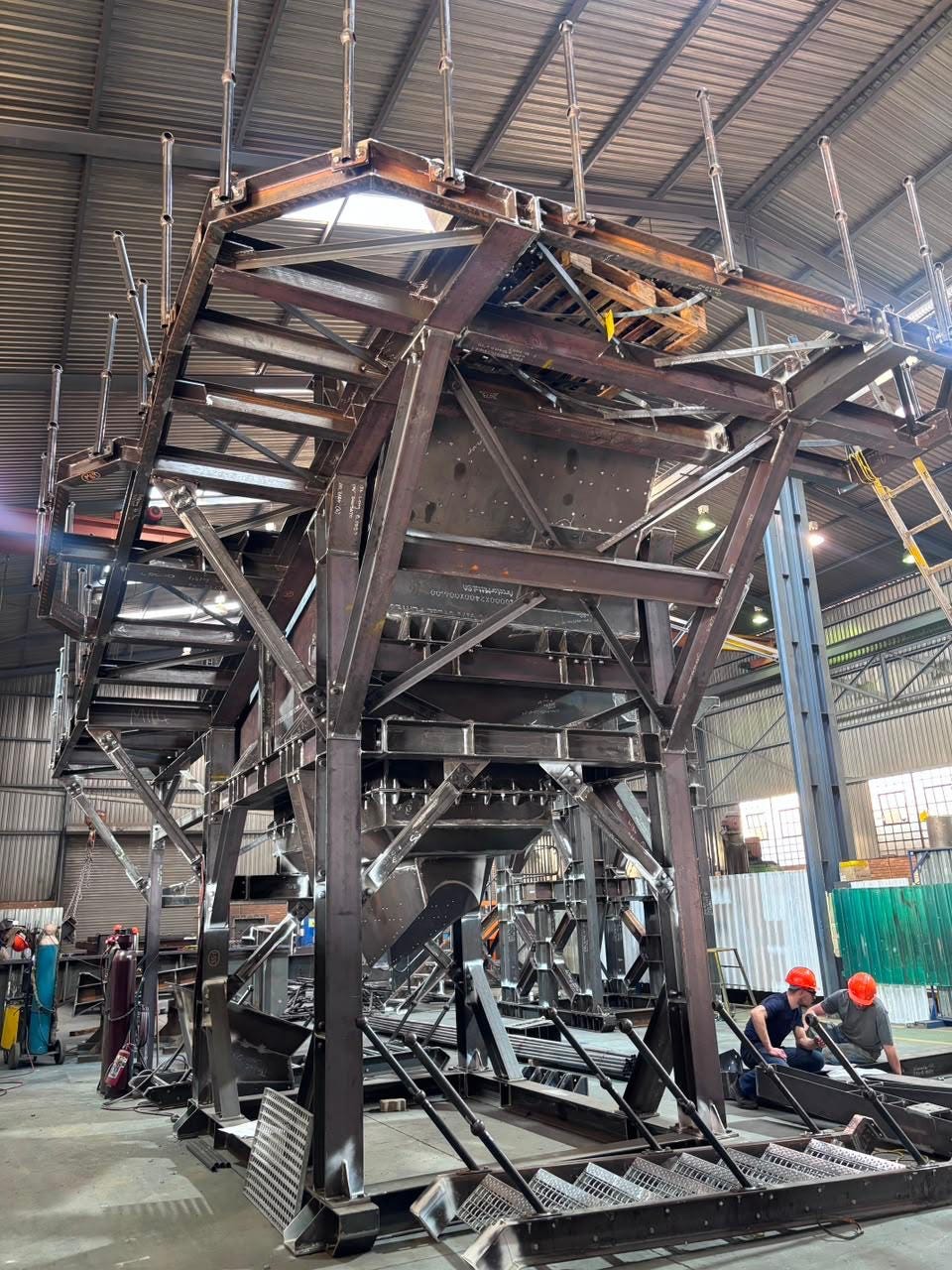
For those who have followed me for a a few years, you know the Bezant story. For those who are newer, let me give you the condensed version.
Bezant is an AIM-listed copper-gold exploration and development company.
Its flagship asset is the Hope and Gorob project in Namibia’s Erongo region, situated within the Matchless Amphibolite Belt — a 350 kilometre linear geological structure that has been producing copper intermittently since the 1950s.
I first covered Bezant at 0.018p per share when it had a market cap of under £2 million. I covered it again at 0.030p. I wrote a detailed analysis in December 2025 when it was trading around 0.075-0.11p.
The thesis has been consistent throughout.
A world class copper-gold asset in a tier one African mining jurisdiction, being developed by an experienced team, at a moment in history when the structural copper supply deficit is becoming impossible to ignore.
Finally, the market is starting to wake up.
At 0.13p today, early holders have already made pretty reasonable returns. But this story is just getting started.
In December 2025, BZT completed its 90% shareholding acquisition of the NLZM (Namib Lead and Zinc Mining Pty Limited) Processing Plant - an existing 180,000 tonne per annum flotation plant near Swakopmund.
Built in 2018, never reaching full capacity, sitting on care and maintenance — Bezant acquired it for $2.5 million upfront plus production royalties, and MetalX engineered the conversion from lead-zinc to copper processing at $2.8 million.
The alternative was spending $50 million+ and two to three years building from scratch. Instead, Bezant bought their way around that entire problem for pocket change.
The moment that acquisition completed, first production moved from years away to months away.
In March 2026, the NLZM Mining Licence ML185 was renewed for ten years to February 2036. The processing plant now has a decade of regulatory certainty locked in — well beyond the entire defined mine life at Hope alone.
In the same month, Unitrans Namibia signed as exclusive mining and logistics contractor - meaning the cost base has stopped being an assumption and became a contracted number.
Unitrans Namibia is an established mining and logistics operator across southern Africa, and agreeing to take on the job is a sign of quality in itself.
They signed a five year agreement covering drilling, blasting, loading, hauling, road maintenance, short-term mine planning and logistics of pre-concentrate from the mine site to NLZM. The chief executive of Unitrans described it as a partnership reflecting a shared focus on safe and efficient execution.
Contracted mining costs are the single largest variable in any open pit operation. They are no longer a variable here.
In March 2026, Bezant then acquired an extra 20% shareholding in Hope and Gorob Mining Pty Ltd from Namibian partner MKH Tangible Investments CC for £1.114 million — half settled in shares at 0.10810p and half in staged cash payments.
MKH retains 10% and their chairman Tango Kandjaba remains a director of Hope and Gorob Mining.
This is the change with the largest single impact on the financial picture and the one I suspect the market has most significantly underpriced.
My December analysis was modelled on 70% ownership. Every revenue/profit/return figure in that piece was on a 70% basis. Bezant now owns 90%.
That’s a 28.5% increase in Bezant’s attributable share of every tonne of copper, ounce of gold and bottom line cash.
Also in March — Bezant raised >£2 million in an oversubscribed equity placing at 0.065p, with the executive chairman and finance director both participating.
Oversubscribed. Management money in.
This stuff needed paying for - yes I agree it could have been managed better. But what’s done is done. Moving on.
In early April, Sound Mining published a new independent Mineral Resource Estimate for Hope and Gorob. Again, the market hasn’t come close to pricing in what it means.
The 2023 resource gave a Hope open pittable resource of approximately 0.41 million tonnes. At a planned feed rate of 400,000 tonnes per annum, that was essentially one year of open pit production.
The 2026 Sound Mining estimate gives an open pittable resource of more than 3 million tonnes gross — a sevenfold increase. At 400,000 tonnes per annum, that is 7.5 years of open pit life from Hope alone.
On Bezant’s 90% attributable basis, the resource now stands at 2,721,402 tonnes containing 33,843 tonnes of copper and 18,280 ounces of gold, with grades of 1.41% copper in the Measured category — the highest confidence classification available under the JORC code.
The 2023 resource was predominantly Inferred — the lowest confidence category. The 2026 resource reclassifies 1.1 million tonnes as Measured and a further 0.5 million tonnes as Indicated.
More than half the resource is now in the two highest confidence categories. This reclassification should change how funds and family offices look at the asset.
The strip ratio has also improved from 11:1 in earlier studies to 9:1 in the updated mine plan. Every tonne of waste you do not move is cash in the bank.
Sound Mining also identified an additional 3.6 million tonnes of mineralisation in inventory that could be upgraded with further drilling, a further 1.3 million tonnes of low-grade material within the pit shell that the ore sorter can upgrade, and significant mineralisation outside the current pit shell with in-house estimates suggesting that a further minimum five years of open pittable production could be added.
The underground resource at Hope — 0.9 million tonnes at 2.04% copper and 0.48g/t gold — is separate and untouched.
The Gorob and Vendome deposits remain the same.
The 97 kilometre strike length along the Matchless Amphibolite Belt remains largely unexplored.
Phase 2 development — a new flotation plant producing 25,000 tonnes of copper metal annually at $290 million revenue — has been brought forward by five years as a direct consequence of the resource upgrade.
At current copper prices well above the $11,500 per tonne assumed in that Phase 2 figure, the revenue projection is already conservative.
Then days ago - finally — the Hartree Metals LLC financing and offtake agreement was signed and delivered.
This was definitive proof for a $7 million secured prepayment facility and offtake agreement.
The financing operates as a secured and convertible facility, available in five tranches with the final tranche payable on pre-production commissioning of the NLZM plant.
A simple four year term, with a 12 month principal and interest repayment grace period. SOFR plus 4.5% interest, nothing unusual. Hartree has the option to convert all or part of the facility into Bezant shares at £0.0016 per share — a 28% premium to the closing price on the day of announcement.
The offtake is life of mine.
Hartree Metals will purchase 100% of copper concentrates produced from Hope and Gorob, on normal market terms, for delivery via Walvis Bay.
Who is Hartree? They’re a leading global commodities trading and asset management firm with 5,000 employees, offices in 50+ locations, and are co-owned by Oaktree Capital Management.
They operate across power, gas, oil, metals, agriculture and securities markets. Hartree Metals specifically focuses on upstream base and precious metal concentrates and intermediates and describes itself as bringing deep expertise in structuring innovative and long-term mine-site commercial prepayment and export arrangements.
This is not a small regional operator or an opportunistic finance house.
This is one of the world’s pre-eminent commodity trading groups, backed by Oaktree Capital Management — one of the most sophisticated alternative investment firms on the planet.
They completed full technical and financial due diligence on Hope and Gorob. They looked at the geology, the metallurgy, the engineering, the cost structure, the management and the jurisdiction. And then they provided $7 million in secured financing and committed to buy 100% of concentrate for the life of mine.
That is the most rigorous, unsentimental third-party validation you’re going to see at this stage of a small mining project.
Hartree does not do charity.
They did this because the numbers work.
They’re also getting a 4 year warrant with a subscription value of $1,750,000 and a warrant exercise price of £0.0011 per share which was the closing share price on 30 October 2025 when the financing term sheet was announced.
If Hartree's percentage shareholding increases to 10% then it will have the right to nominate a director to the board - which itself would send a strong signal of confidence to the market.
These people are commodity traders. They don’t want a mine.
They want product.
And production is targeted for Q3 2026.
Now let’s say we meet this target.
In December, I outlined a potential bull case scenario in which historical exploration losses accumulated during years of development work could be carried forward and applied against Namibian corporate tax liability in the first two years of production — effectively shielding the initial production years from circa $30 million in cumulative tax payments.
I flagged it at the time as unconfirmed, requiring detailed Namibian tax due diligence.
I am no longer being cautious on this point. If you dig through the data, historical exploration losses should be sufficient to offset the Namibian corporate tax liability for Years 1 and 2 of production entirely.
This is standard tax treatment in mining acquisitions in many jurisdictions and Namibian mining law permits it.
The practical effect: Years 1 and 2 of production are tax-free. Every dollar of EBIT in the first two years flows directly to net profit.
This is the confirmed scenario.
And then we have the metal prices.
My December analysis used these assumptions:
Copper: $11,165 per tonne
Gold: $4,180 per ounce
Silver: $53 per ounce
As of 14 June 2026:
Copper: approximately $14,175 per tonne ($6.43 per pound) — 27% above December assumptions.
Copper briefly rose above $14,500 per tonne intraday in January 2026. The structural backdrop has never been stronger - Jefferies forecasts an average annual supply deficit of 491,000 tonnes through 2030.
The annual TC/RC benchmark — the fee smelters earn for processing copper concentrate — settled at $0 per tonne in 2026, the lowest ever recorded. Smelters are competing so aggressively for material that they are processing it for free.
Bezant steps directly into that environment as a new producer with a signed Hartree offtake.
Gold: around $4,200 per ounce. Essentially unchanged from December (though it has gone up and back down again).
Silver: approximately $68 per ounce — 28% above December assumptions.
For my modelling below I am using deliberately conservative prices — $13,000 per tonne copper, $4,000 per ounce gold, $60 per ounce silver — so that the numbers hold up even if markets pull back. If spot prices rise, every figure below has further upside.
If you’ve been following correctly, we have two sites.
The Hope and Gorob mine site, 250 kilometres southwest of Windhoek, where conventional open pit methods target copper-bearing lenses using 5-metre benches with a 9:1 average strip ratio.
Ore is crushed on site to -40mm and screened at 17mm. The coarse fraction runs through the Steinert XRT ore sorter — 45% mass yield at 85% copper recovery — reducing haulage volumes by nearly half.
The fines, averaging 2.76% copper due to preferential breakage of friable chalcocite, bypass the sorter and go direct to trucks.
At NLZM near Swakopmund, the pre-concentrate enters the converted flotation circuit. Chrysocolla oxide material is identified during grade control and parked rather than processed, preserving metallurgical recoveries and maintaining optionality for future VAT leaching.
Design recovery on sulphide material is 90% copper.
Total project capital: $12.8 million.
Bezant’s 90% share: $11.52 million.
A greenfield plant of equivalent capacity would cost $50-100 million and take two to three years to build.
All figures are on Bezant’s 90% attributable basis.
Tax: zero, Years 1 and 2, confirmed loss carryforward.
Metal prices: conservative model ($13,000 copper, $4,000 gold, $60 silver).
Payabilities: 85% copper, 90% gold less 0.5g/t deduction, 100% silver less 15g/t deduction.
Year 1
Mining targets 431,000 tonnes of ore at 1.05% copper — lower-grade near-surface material mined first to expose the higher-grade sulphide core beneath.
Strip ratio averages 9:1.
Total material movement approximately 4.3 million tonnes.
Unitrans mobilised and contracted. After ore sorting and flotation at NLZM, production on Bezant’s 90% basis is approximately 4,050 tonnes of contained copper, 2,800 ounces of gold, and 42,000 ounces of silver.
Revenue:
Copper: 4,050t × $13,000 × 85% payability = $44.75 million
Gold: 2,800oz × $4,000 × 90% payability = $10.08 million
Silver: 42,000oz × $60 = $2.52 million
Total Year 1 Revenue: $57.35 million
Operating costs (90% basis): $20.5 million — Unitrans contracted mining, crushing and ore sorting, trucking to NLZM, plant processing at $17.60 per tonne, site overhead, G&A.
Approximately $54 per tonne of RoM ore.
Capital depreciation and sustaining capex: $2.6 million.
EBIT: $34.25 million
Tax: $0 — confirmed loss carryforward
Year 1 Net Profit: $34.25 million
On $11.52 million of invested capital, Year 1 alone generates a 3x return.
Capital is recovered approximately six months from first production.
Everything after that is profit on a paid-for asset.
Obviously, ramp-up is never perfect. If metallurgical recovery averages 87% rather than 90% for the first six months, revenue falls by roughly $1.5 million. If mining productivity runs slightly below target, costs rise by perhaps $1.5-2 million. A realistic real-world Year 1 net profit might be around $30 million rather than $34.25 million.
Still, by any measure, profitable.
Year 2
Operations hit full stride. Mining steps up to 486,000 tonnes at 1.24% copper — an 18% grade improvement as the pit moves past the oxide cap and into fresher, higher-grade sulphide material.
NLZM running at nameplate 180,000 tpa. Metallurgical recoveries stabilised at design. Contractors fully embedded and the plant team knows the ore (this matters a lot more than many realise).
Production (Bezant 90%): approximately 5,355 tonnes copper, 3,100 ounces gold, 62,000 ounces silver.
Revenue:
Copper: 5,355t × $13,000 × 85% = $59.2 million
Gold: 3,100oz × $4,000 × 90% = $11.16 million
Silver: 62,000oz × $60 = $3.72 million
Total Year 2 Revenue: $74.08 million
Operating costs (90%): $24.3 million. Unit cost per tonne drops slightly as fixed costs spread across higher throughput — operating leverage beginning to show.
Capital depreciation and sustaining: $2.8 million.
EBIT: $46.98 million
Tax: $0 — confirmed loss carryforward
Year 2 Net Profit: $46.98 million
Cumulative Year 1-2 Net Profit: $81.23 million
On $11.52 million of invested capital. In 24 months. At conservative metal prices.
That is a >7x return. At spot prices rather than conservative model prices, cumulative two year profit approaches $95-100 million.
And these are the lowest ore grade years of the mine plan. Year 3 averages 1.36% copper. Year 4 runs 1.33%. Year 5 reaches 1.86% as the operation mines into the high-grade footwall contact. The returns only improve from here.
My December analysis modelled 70% ownership, $11,165 copper, and full Namibian corporate tax. The cumulative two-year net profit in that scenario was approximately $30 million.
Today’s confirmed picture is 90% ownership, $13,000 conservative copper, and zero tax.
Cumulative two-year net profit: $81.23 million.
The uplift is $51.23 million — more than 170% above December’s numbers.
It comes from three sources: confirmed tax shield adding approximately $28-30 million, increased ownership from 70% to 90% adding approximately $13 million, and higher conservative copper price adding approximately $9-10 million.
Yes - there are risks. Lots can go wrong when building a mine, but this investment case is very forgiving.
And it’s not like this revenue generation will start on day one - a ramp up will be needed.
but at 0.13p, the market cap is approximately £28.5 million.
A company that should, all going well, generate $81.23 million in cumulative net profit in its first two full production years at conservative metal prices. On a mine with 7.5 years of defined open pit life. With Gorob, Vendome, underground resources, and 97 kilometres of largely unexplored strike length behind it.
With a tier one global commodity trader as both financier and life of mine offtake partner. With contracted mining costs, signed permits, a refurbished plant and production targeted for Q3 2026.
This market cap makes no sense whatsoever in the context of these numbers - except under one framework.
Developer-to-producer.
Developer-to-producer is the most powerful re-rating event in junior mining. It doesn’t happen gradually. It happens when an RNS lands confirming first concentrate shipped and Hartree pays.
That moment is probably around September 2026.
At that point, the peer group changes.
Bezant is then compared to producing copper assets. Producing copper miners generating $35-47 million in annual net profit do not trade at £28.5 million market caps.
They trade at 3x, 4x, 5x annual earnings.
Even at a deeply conservative 2x Year 2 earnings, implied market cap exceeds £200 million.
At 4x, it exceeds £400 million.
Whether the market gets there in six months or 18 months is not something I can predict. That it gets there eventually, assuming continued execution, seems to me almost inevitable.
Finally.
Hartree Partners completed full technical and financial due diligence on Hope and Gorob before providing $7 million in financing and committing to buy 100% of concentrate for the life of mine.
They looked at everything. That’s why it took so bloody long. And then they wrote the cheque and signed the offtake.
Worth thinking about.
The Bottom Line
Two and a half years ago I called this a speculative bet worth tucking in the bottom drawer.
A year ago I called it a ground floor opportunity.
In December I said the risk-reward was firmly tilted toward reward.
Today I am saying something simpler: the work is done.
The financing is in place, the offtake is signed, the plant is being refurbished, the contractors are on the ground, the resource is sevenfold larger than we thought.
Ownership is 90%. The tax position is confirmed. Copper is at $14,175 per tonne with a structural supply deficit through 2030.
Production comes NEXT QUARTER.
One RNS away from becoming a producer. One Hartree payment away from the re-rating.
Watch this space.
Great write up Charles. I am long and staying long!
Good informative article.