

Amaroq
Greenlandic Trailblazer enters Main Market

Good Morning Team.
I’m unofficially ‘on holiday’ now.
But with Amaroq moving to the Main Market I thought it may be wise to catch you up on the state of play.
Of course, if you want further technical, granular detail, there are several excellent broker notes out there. But where Cannacord wants to sell you the science, I want to paint you a picture.
This email may be too long, so head to the site to read in full.
Let’s dive in.
1. Executive Summary
At 8am today, 31 July 2026, Amaroq’s shares transfer from AIM to the Main Market of the London Stock Exchange, with Citigroup (yes that Citigroup) sponsoring alongside Canaccord Genuity and Panmure Liberum.
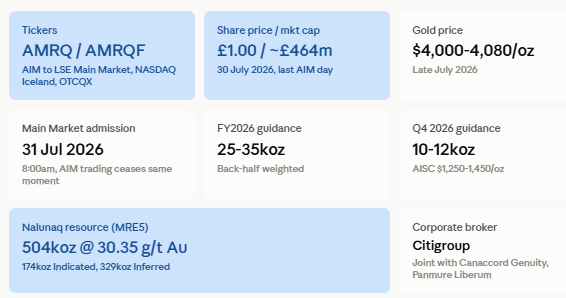
No new shares are being issued — this is a pure listing upgrade on the existing share register, with the FTSE AIM 100 and FTSE AIM All-Share deletions taking effect from 3 August.
This single event is the hinge of this report, because it lands in the middle of the busiest operational quarter in the company’s history.
Amaroq is simultaneously:
Ramping Nalunaq gold production through a freshly commissioned flotation circuit, targeting 25-35koz for FY26, weighted to H2;
Sitting on a gold resource that just grew again — MRE5 confirmed 504koz at 30.35 g/t Au, up 10.6% in the higher-confidence Indicated category;
Running six near-simultaneous exploration programmes across gold, base metals, rare earths and iron-copper-gold targets;
Carrying a critical-minerals by-product story at Black Angel (germanium, gallium, cadmium) that intersects directly with Western governments’ most acute supply-chain anxiety; and
Doing all of this against a gold price sitting around $4,000-4,080/oz.
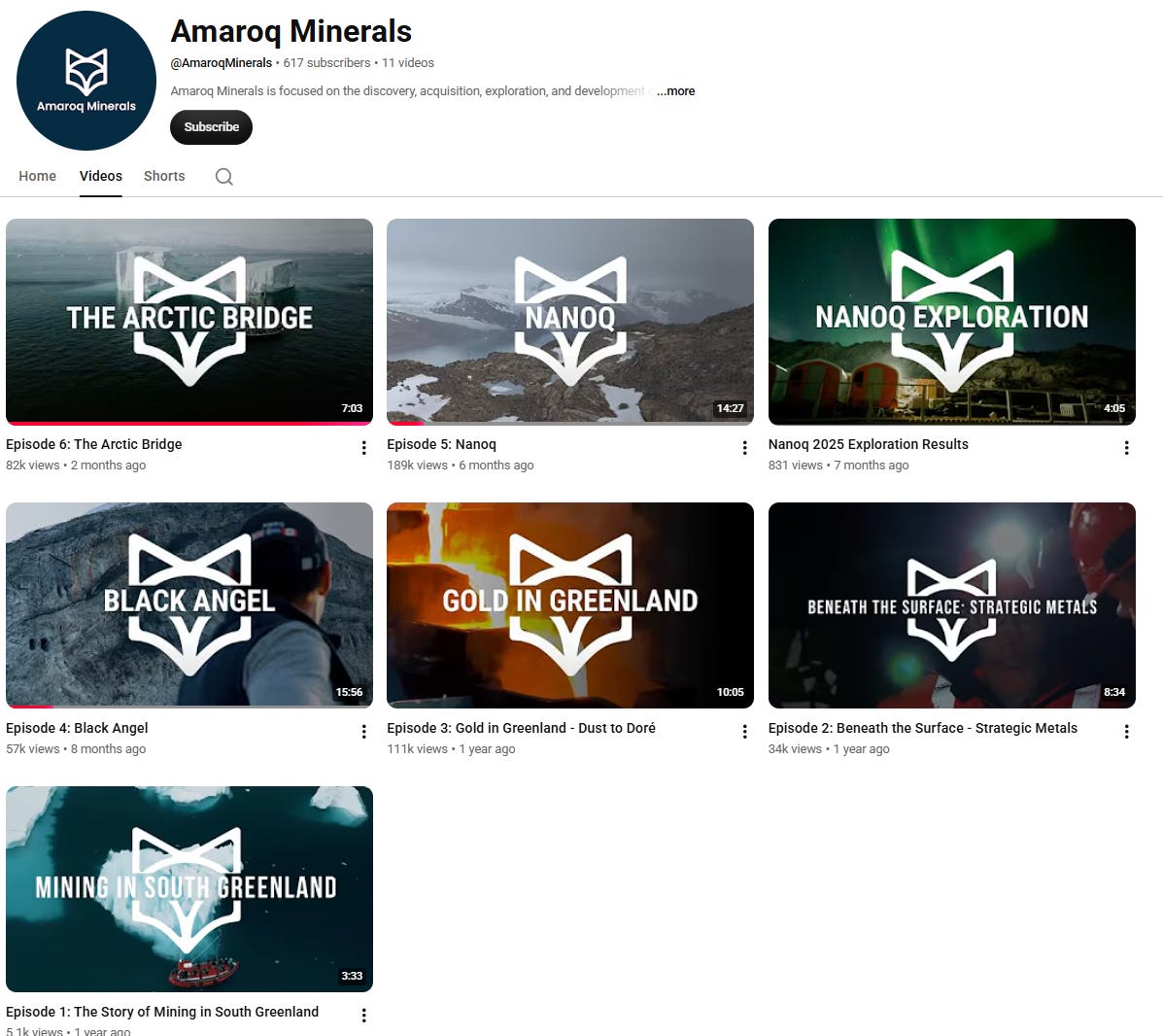
To get a sense of both the scale and challenges, I urge you to watch the company’s video series, which will give you more information than words can hope to:
https://www.youtube.com/@AmaroqMinerals/videos
I’ll go asset by asset, then cover the corporate, financial and geopolitical layers, and then explain why why Q4 2026 is where the investment thesis demands a re-rate.
For context, Amaroq has been building in Greenland since acquiring Nalunaq in 2015, but really started ramping up exploration from 2017 at the start of its sustained operational build-out.
It is, by a wide margin, the only company to have taken a modern Greenlandic mine from acquisition through to steady-state production.
Everything else sits on top of that base capability.
Nalunaq: The Cash Engine
2.1 History and geology
For those hwo have the time, please listen in to Eldur’s candid interview with me from late May.
All is going according to plan thus far.
Release date: 27 May 2026
Nalunaq previously operated from 2003 to 2013 under a different owner before closing due to a cocktail of low gold prices and high costs.
Amaroq acquired the asset in 2015 and spent years drilling, developing infrastructure, and de-risking before pouring first gold.
The deposit is hosted in a narrow, high-grade Main Vein across four zones — Mountain, Target, South and Valley Blocks — with a well-documented ‘nugget effect’ (coarse, unevenly distributed gold) that historically caused surface drilling to understate grade relative to what underground development and mining later confirmed.
Amaroq’s technical team addressed this directly by building a bespoke ‘Dolerite Dyke Model’ to improve targeting, and by adopting a three-stage confidence-building approach: surface drilling to locate the vein, infill drilling for mine planning, and then reconciling drill results against actual mined grade.
2.2 Resource growth: MRE4 to MRE5
The April 2025 resource update (MRE4) delivered a 51% increase in contained gold to 484koz.
MRE5, published 29 July 2026 with an effective date of 1 December 2025, took this to 504koz at 30.35 g/t Au:
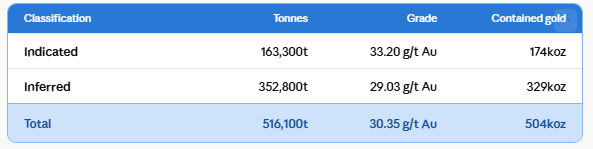
The Indicated category grew by 10.6%, driven by 2025 underground infill drilling that extended the classification boundary within the Upper Mountain Block — and this more than replaced the ounces depleted through a full year of mining.
Independent consultant Bara Consulting also tested the resource’s sensitivity to cut-off grade and found that doubling the cut-off to circa 12 g/t Au would reduce contained gold by only around 12%, which is a good indicator of how much of the deposit sits well above the reporting threshold.
A meaningful chunk of the resource — including the very high-grade MB HG2 domain at 61.7kt remains classified as inferred simply due to current drill density, and represents a clear priority for further definition drilling.
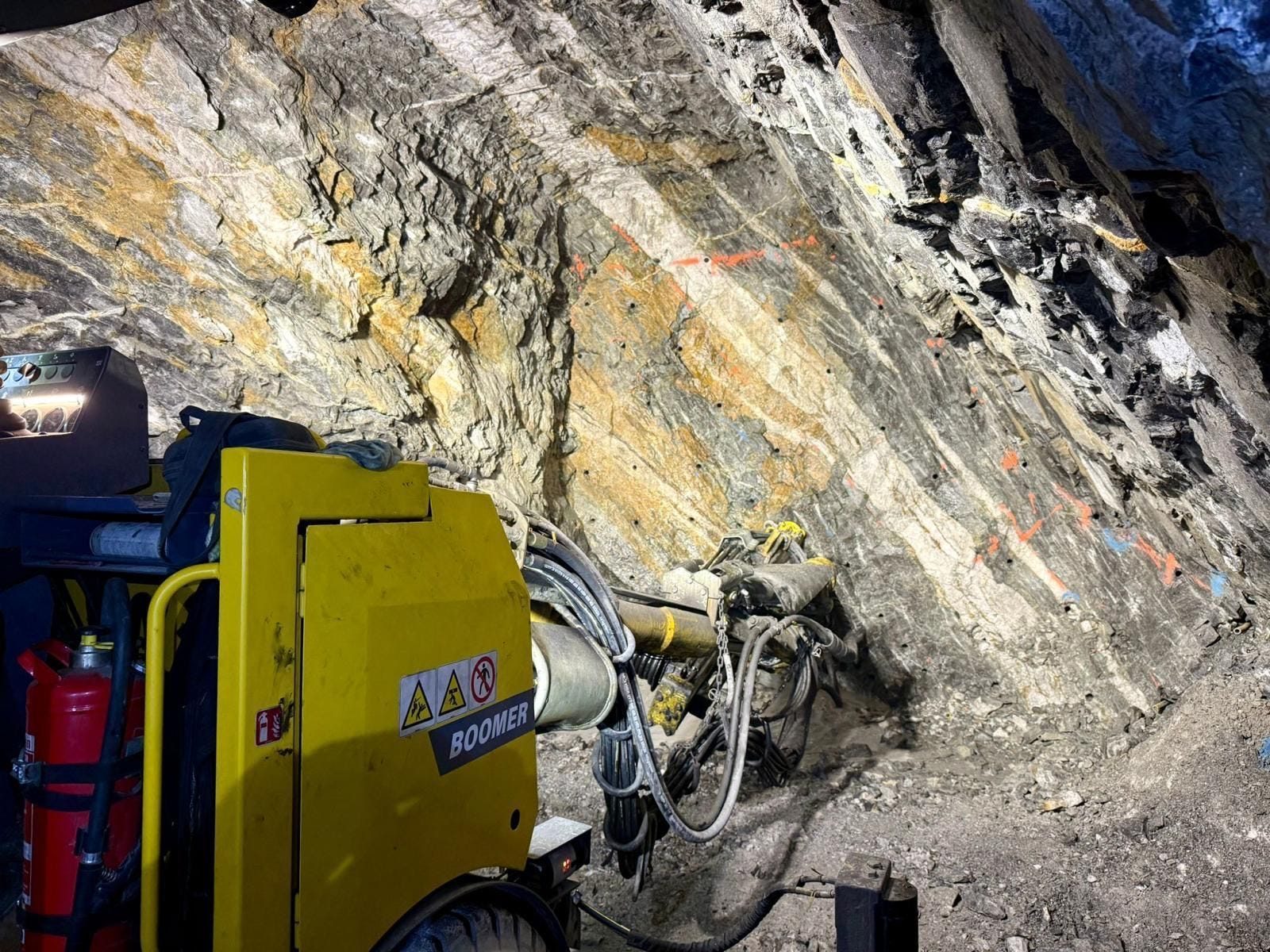
Separately, Bara identified an Exploration Target of 400,000-2.2 million tonnes at 10-30 g/t Au for further Main Vein potential — yes conceptual, but indicative of how much running room the deposit still has along strike and at depth.
Importantly, MRE5 doesn’t even capture the most recent underground results: a July 2026 drilling update reported intersections up to 132.5 g/t Au over 0.5m (NAL-UG-2601) and 132.0 g/t Au over 0.5m (NAL-UG-2640), all post-dating the MRE5 cut-off — meaning the next resource update starts with upside already banked.
2.3 Production ramp-up and Phase 2
2025 closed with full-year gold production of 6.35koz (~6.6koz per the January 2026 update), above the midpoint of 6-7koz guidance, on throughput of 300t/d achieved by year-end.
From 1 October 2025, Nalunaq transitioned to a fully owner-operated mining model — Amaroq bought its own underground fleet rather than relying on contractors — and productivity rose across the board as a result.
Q1 2026 delivered revenue of $18.9 million (versus zero in Q1 2025) from 2,970oz of gold sales at an average realised price of $4,656/oz, with gross profit of $9.8 million and net profit of $2.4 million.
Feed grade averaged 19.9 g/t, above the 14-15 g/t full-year guidance range, and gravity-only recovery came in at 61%, in line with the ~60% planned rate for the Phase 1 circuit.
For perspective, global average gold feed grades typically come in at around 1-1.5 g/t.
In December last year, one intersection came in at 1,840 grams of gold per tonne (g/t Au) over 0.5 metres in Mountain Block - a number which in technical terms, is sickeningly rich.
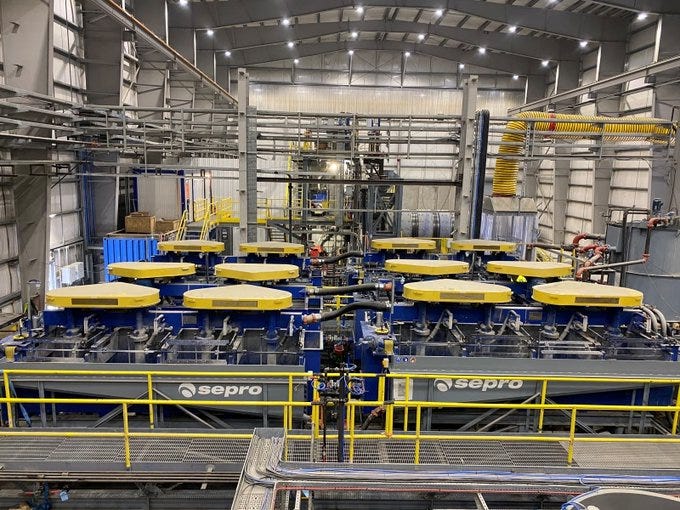
The Phase 2 flotation circuit — the project that required a deliberate, planned production shutdown back in October 2025 — was completed and commissioned on schedule in June 2026.
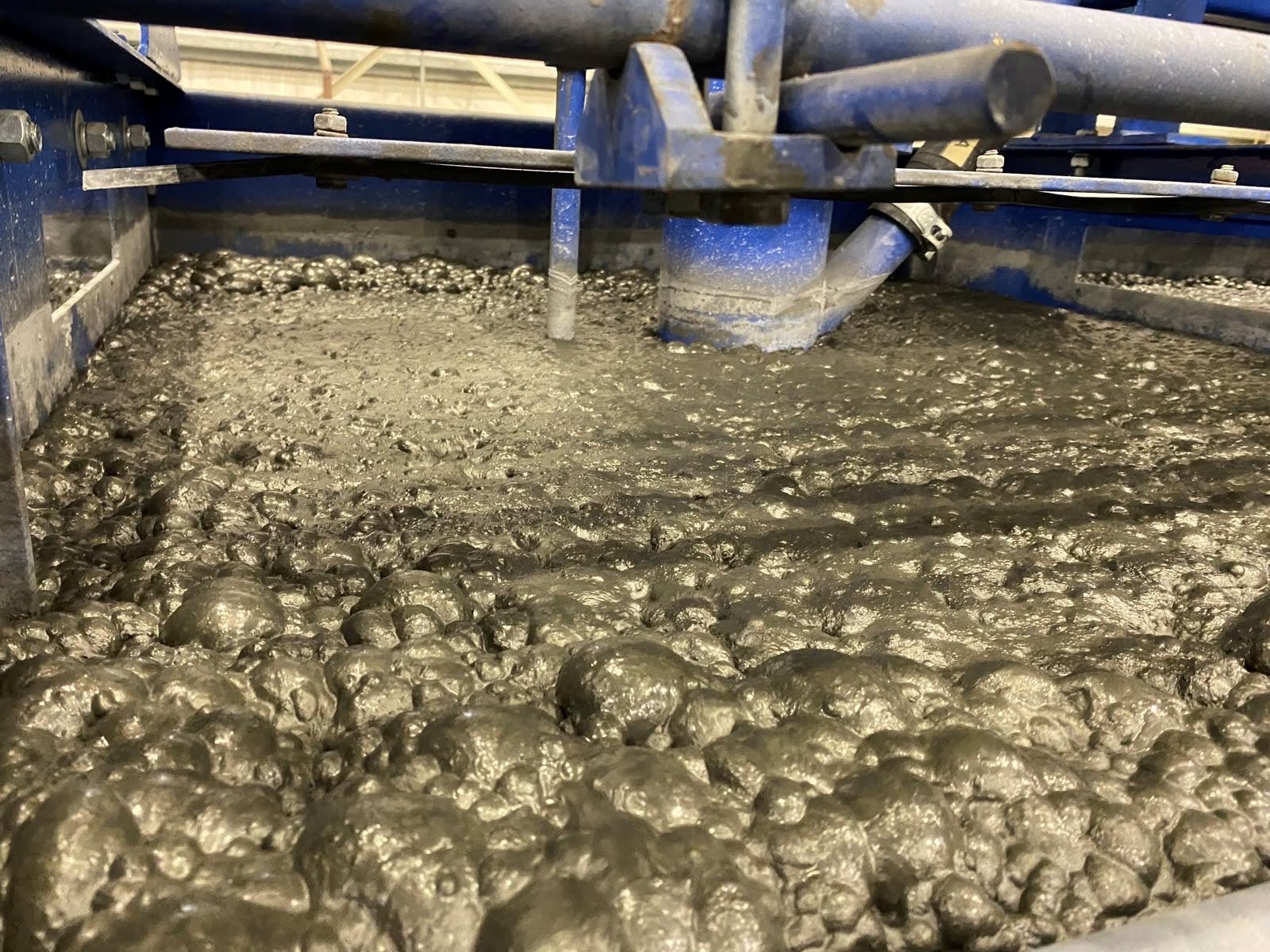
First flotation concentrate has now been produced alongside the existing Dore bars, and overall recovery is expected to rise from the 50-70% gravity-only range to 90-95%.
Tailings at 6g/t gold, stockpiled since first pour in late 2024, will now be progressively reintroduced to the plant to recover the additional contained gold that had simply been set aside during commissioning.
Guidance has been consistent and reiterated at each update: 25-35koz for FY2026, with H1 at 7-10koz and Q4 alone guided at 10-12koz as flotation reaches full effect.
Full-year cash costs are guided at $44-47 million and AISC at $69-73 million, with Q4 AISC specifically guided down to $1,250-1,450/oz as the owner-operator transition lowers unit costs.
At a gold price around $4,000/oz, that implies a per-ounce margin in the region of $2,500-2,750 once the circuit is running at target rates — a different economic picture from the commissioning-year numbers.
2.4 Ongoing derisking
Underground drilling at Nalunaq has evolved from a pure resource-definition exercise into a key part of the mining operation - the company now maintains a rolling 12-24 month drilled production inventory ahead of mining, specifically to reduce grade uncertainty and support consistent output.
The July 2026 update showed 16 of 37 assayed holes above 30 g/t Au (the MRE4 average) and 30% above 60 g/t Au, at a programme average of 42.8 g/t Au.
The next phase targets previously untested western portions of the Main Vein via the planned 810 Exploration Drive — ground that could extend the 2 million ounce conceptual exploration target into something more concrete over time.
3. Nanoq: The District-Scale Bet
Nanoq is Amaroq’s blue sky potential.
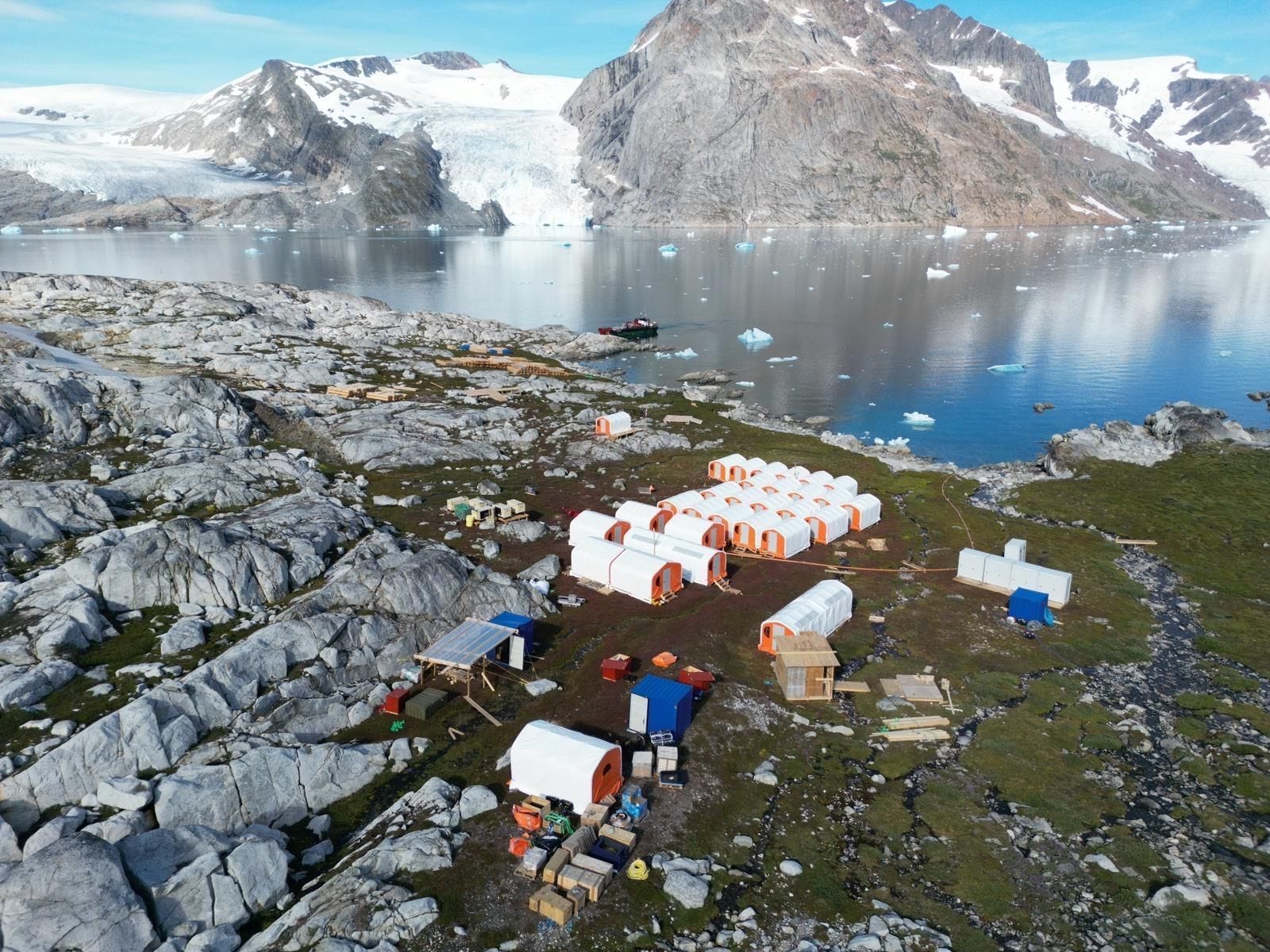
Located 30km from Nalunaq within the same Nanortalik Gold Belt, it was first identified in the 1990s but never systematically explored until Amaroq’s 2024 scout drilling and full 2025 campaign — the first comprehensive exploration and first major drill programme on the project since 1997.
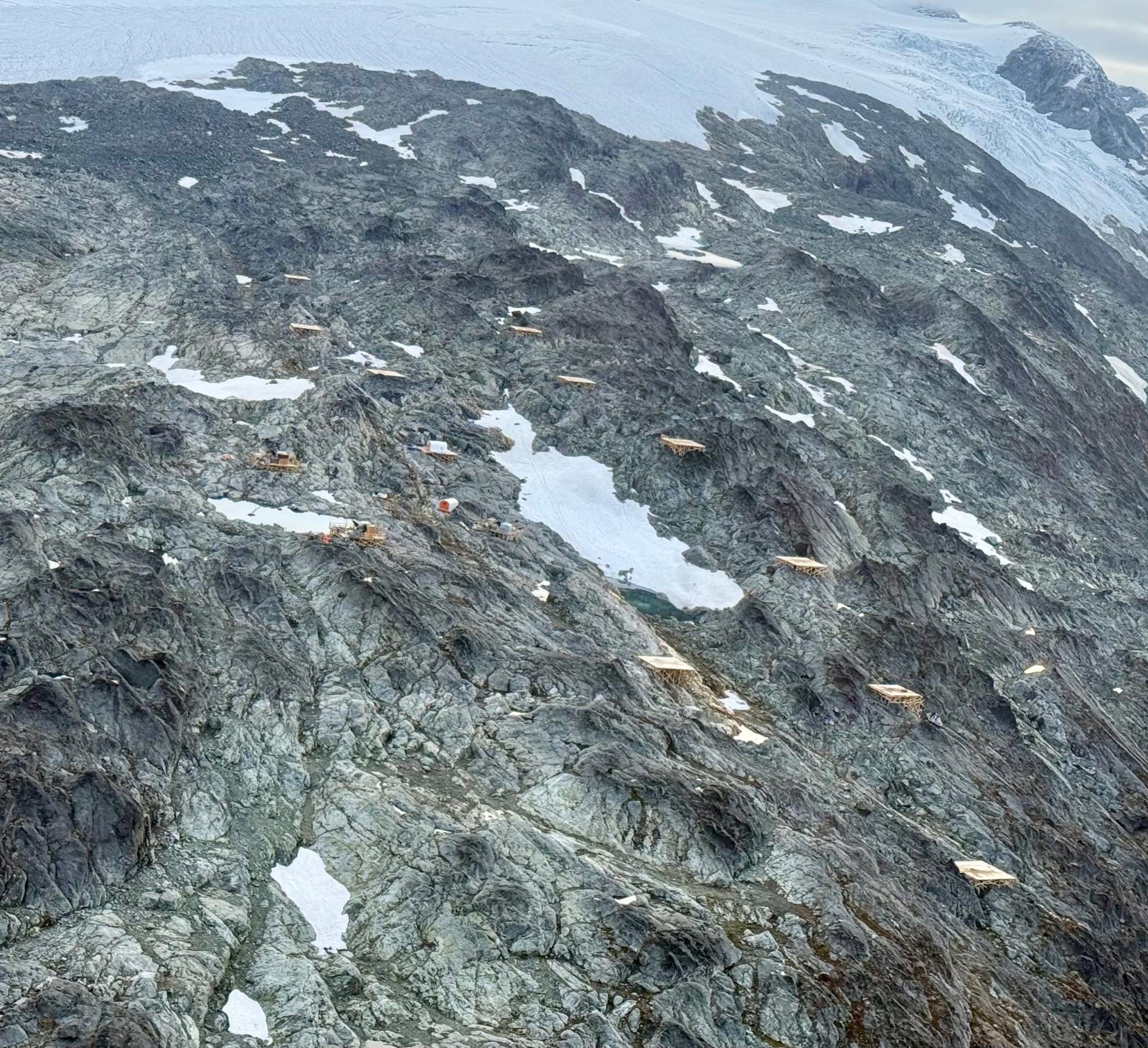
The 2025 season saw a 45-person exploration camp built in July, geological mapping in August, and drilling from mid-August to late September — completed ahead of schedule and within budget.
Results saw 4,807m across 27 holes testing around 600m of strike within the Central Zone, with 63% of holes intersecting mineralisation including standout intercepts of 187.4 g/t Au over 1.5m and 19.6 g/t Au over 4.9m, with broader lower-grade zones up to 9m thick (3.83 g/t Au over 9.0m; 6.7 g/t Au over 7.39m) — all within the top 70m of what is interpreted as a much larger system.
Copper is also present, with intersections up to 1.12% Cu over 0.5m (though no direct gold-copper correlation has yet been established).
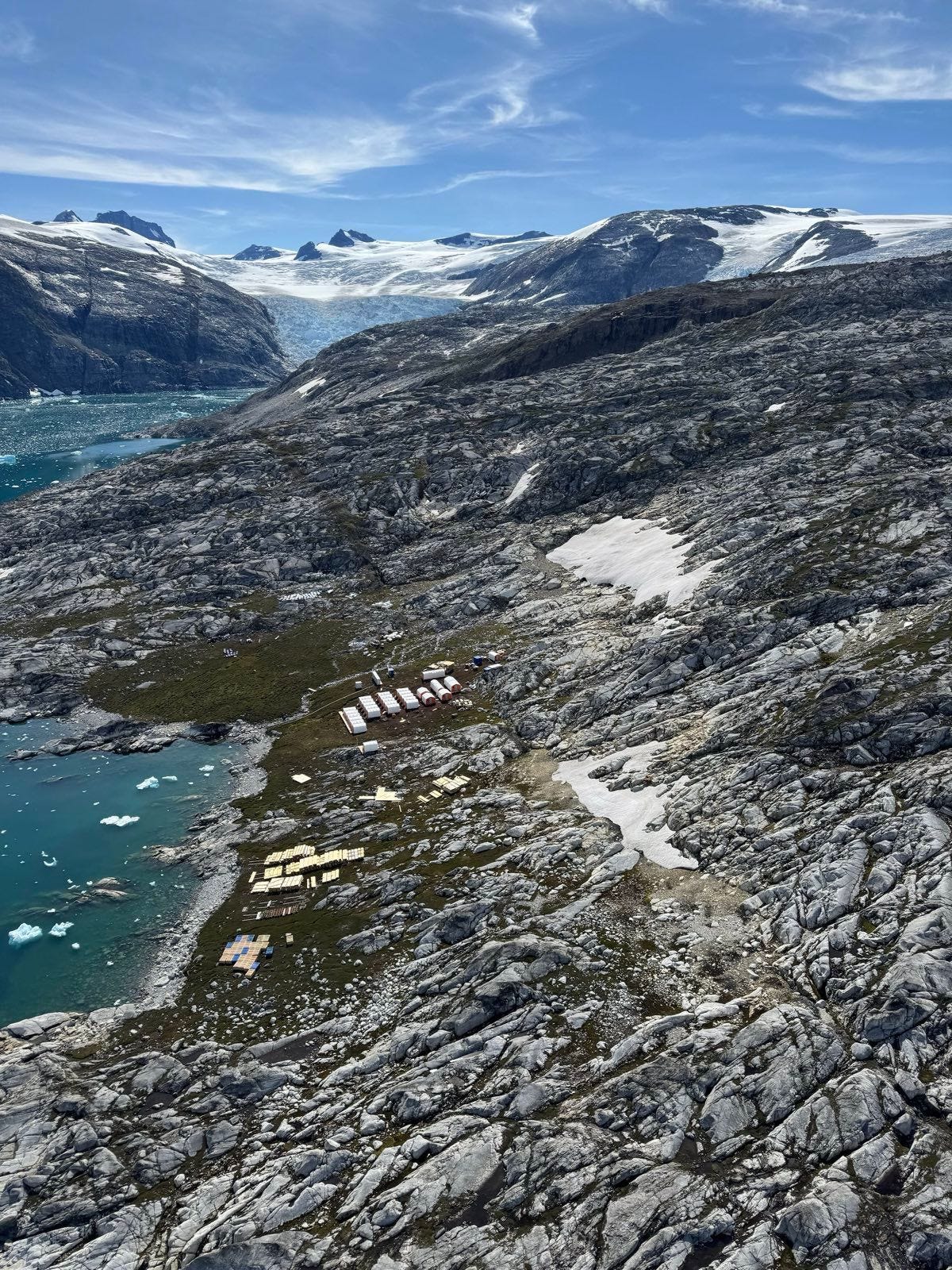
Structurally, Nanoq is geologically distinct from Nalunaq - rather than a single narrow high-grade vein, it hosts multiple gold-bearing quartz veins across different rock units in nested saddle-reef fold hinges — a style of mineralisation historically associated with continuous, high-grade, large-tonnage systems (the geological analogy management draws is to the saddle-reef deposits behind Victorian-era Australian gold rushes).
That geometry also opens the door to open-pit mining at Nanoq, a different and potentially lower-cost development path than Nalunaq’s underground operation.
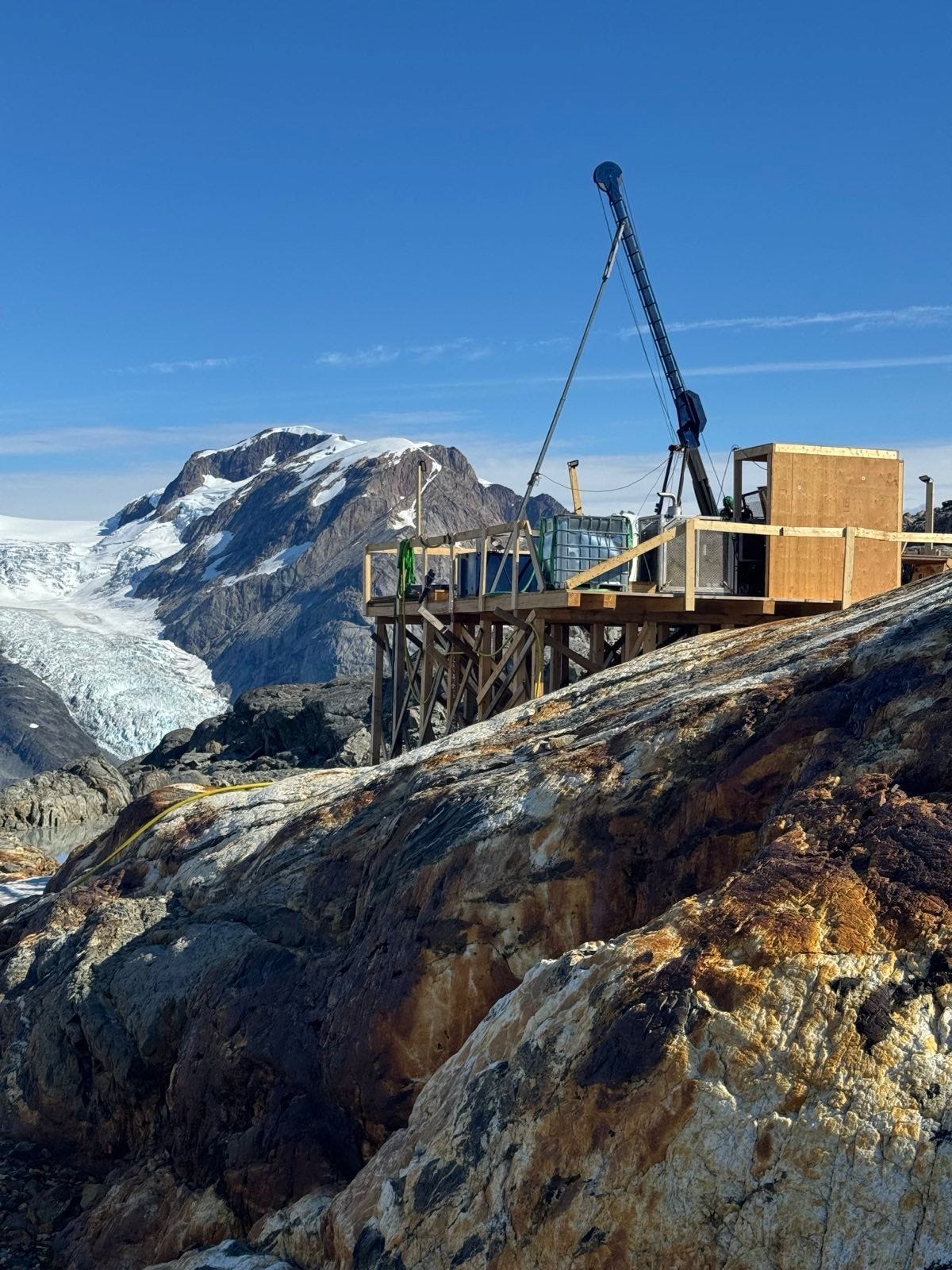
Follow-up prospecting extended the interpreted Central Zone strike to circa 1,500m (with indications the system continues beneath the ice cap) and discovered an entirely new parallel structure 500m to the west — the ‘West 1’ Zone, a 1km quartz vein system in the same host sequence, with surface sampling up to 9.54 g/t Au.
Some 100kg of metallurgical samples have been sent to SGS for initial test work assessing how Nanoq ore might perform through the existing Nalunaq processing flowsheet, and the company is already considering short-haul, ship-based transport — including a possible 3km access road to a harbour site — to feed material to Nalunaq’s mill rather than building standalone processing infrastructure.
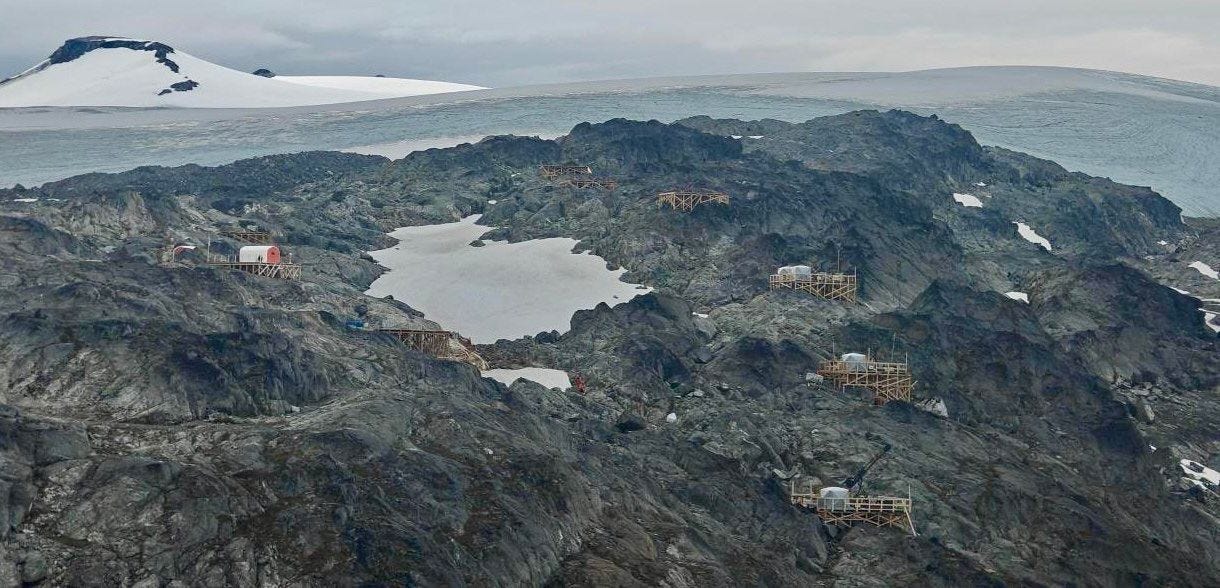
The 2026 programme is now underway - systematic drill testing of the Central Zone through July/August, specifically designed to build the geological continuity and data density needed for a maiden Mineral Resource Estimate.
SRK Consulting UK is supporting the geological modelling. This is the single highest-optionality item on the exploration slate — management has previously suggested Nanoq could ultimately be larger than Nalunaq itself — and a maiden resource, even a modest one, would be the first hard number the market has to work with.
You may wish to listen to the company’s VP Exploration explain the entire exploration portfolio in his own words:
Release date: 8 July 2026
4. West Greenland Hub: Black Angel, Kangerluarsuk, and the Critical-Minerals Surprise
4.1 Acquisition and history
Amaroq acquired the past-producing Black Angel zinc-lead-silver mine and the adjacent Kangerluarsuk exploration licences in mid-2025, creating the ‘West Greenland Hub’ - its second mining district and a deliberate diversification beyond gold.
(For reference, this high gold, high copper pricing is an abomination in historical terms. When one’s doing well, the other tends to suffer. Prices tend to revert to the mean).
Black Angel was operated by Cominco (now Teck) and later Boliden from 1973 to 1990, producing roughly 11.2 million tonnes at an average of 12.6% Zn, 4.1% Pb and 29 g/t Ag — easily one of the highest-grade base metal mines of its era, closed only because commodity prices at the time made continued operation uneconomic.
Substantial infrastructure survives on site - underground workings, a 20+ person camp, an aerial tramway and a deep-water port.
The current defined resource stands at 3.2Mt @ 8.8% Zn and 3.0% Pb (Indicated) plus 0.5Mt @ 4.73% Zn and 2.2% Pb (Inferred), with historical drilling at the Deep Ice body returning intercepts as strong as 6.9m @ 13.1% Zn and 19.5% Pb — a clear first target for resource growth.
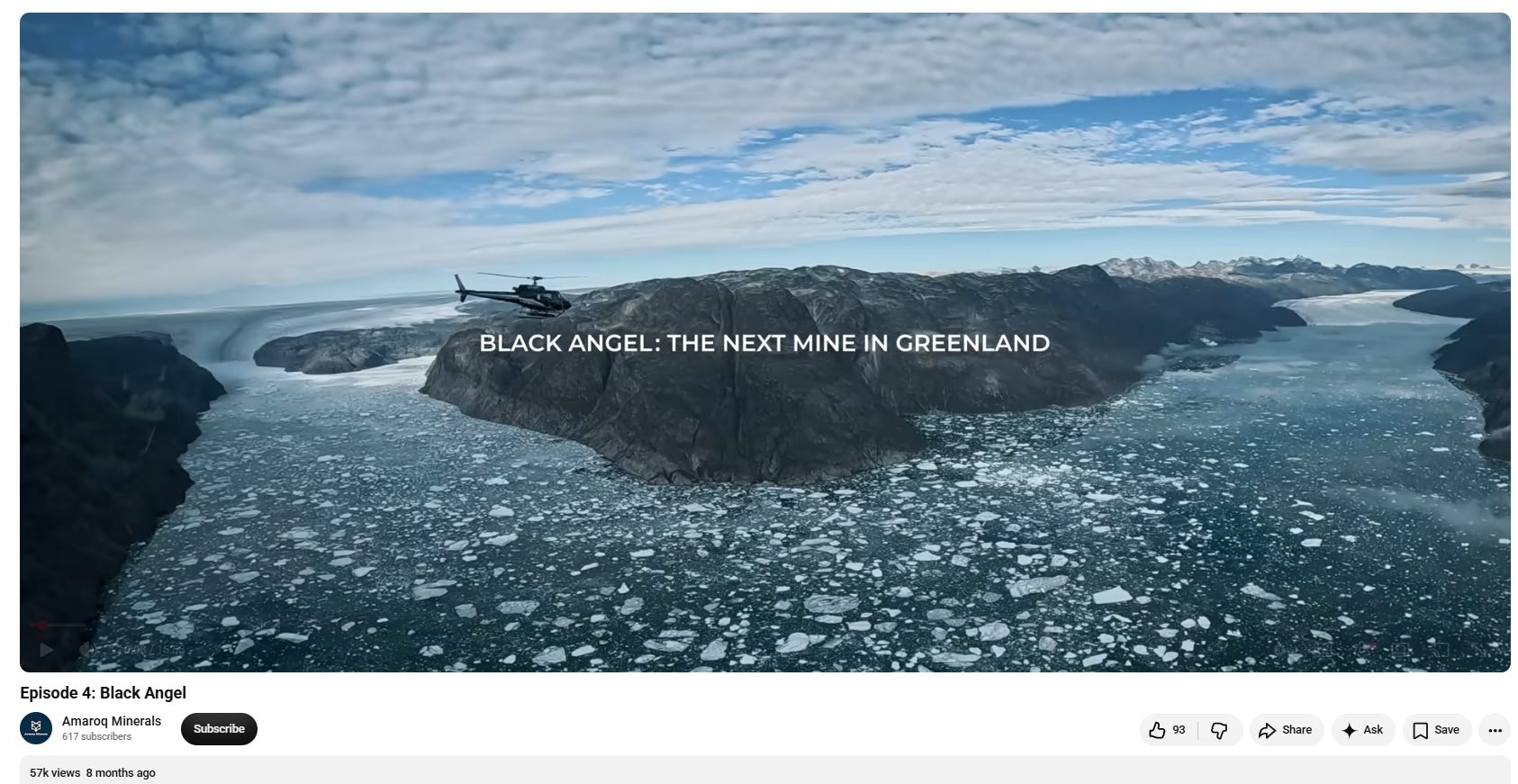
If you only watch one video, watch this one.
All conditions precedent to the Black Angel acquisition were satisfied by November 2025. The West Greenland Hub is structured to remain 100% owned by Amaroq, deliberately kept outside the 51/49 Gardaq joint venture so that shareholders capture the full upside rather than sharing it with a JV partner.
4.2 The germanium-gallium-cadmium discovery
In November 2025, Amaroq re-assayed a historical bulk sample from the Angel and Cover deposits — material the previous operators had never tested for a broader element suite — and the results reframed the entire project.
Average grades came back at 24.6% Zn, 28.1% Pb and 295 g/t Ag (confirming the historic high-grade character), but also revealed average germanium of 44.4 ppm (up to 93.7 ppm), gallium of 21.2 ppm (up to 59.4 ppm) and cadmium of 1,328 ppm (up to 3,500 ppm).
Under preliminary mass-balance assumptions, if these elements report to a future zinc concentrate as expected, concentrate grades could reach roughly 102 ppm Ge, 48.5 ppm Ga and 3,040 ppm Cd — all considered potentially commercially significant for by-product recovery.
This matters because germanium and gallium sit at the sharpest edge of Western critical-minerals anxiety. Per USGS data cited by the company, China controls approximately 98% of global gallium production and 68% of germanium production, and has imposed export restrictions on both since 2023.
Germanium underpins fibre optics, infrared/night-vision optics, satellite solar cells and high-frequency electronics; gallium underpins semiconductors, LEDs, 5G infrastructure and radar/electronic-warfare systems.
Both sit on the EU Critical Raw Materials List and the US Critical Minerals List.
CEO Eldur Olafsson framed it directly - finding these elements in a mine capable of a relatively fast restart ‘underscores the strategic importance of Amaroq’s expanding portfolio to Western supply chains.’
Critically, Black Angel is not a greenfield critical-minerals bet — it’s a 17-year-proven, brownfield restart with existing permitting precedent, which is the profile governments have shown they’re willing to fund quickly (see Section 7).
4.3 Kangerluarsuk and 2026 work
Kangerluarsuk sits roughly 12km north of Black Angel in the same Palaeoproterozoic Karrat Group host geology, with historical surface sampling up to 45% zinc and 596 g/t silver in float and outcrop, and channel samples as strong as 41% Zn over 1m.
These are some crazy numbers.
Despite that, it remains entirely undrilled — a rare ‘drill-ready, unexplored’ high-grade target. Amaroq plans maiden drilling here in 2026 or 2027.
Through the current field season, work at the Hub is focused on rehabilitating surface facilities, updating historical technical studies, and designing the geophysics and drill programme needed to grow Black Angel’s resource toward a 10+ million tonne target — the scale needed to underpin a Phase 1 restart, currently targeted for 2028.
5. Ilua Rare Earths, Minturn IOCG, and Stendalen: The Gardaq JV Pipeline
These three projects sit inside Gardaq A/S, the 51/49 joint venture between Amaroq and GCAM established in 2023, kept structurally separate from the fully-owned Nalunaq/Nanoq/West Greenland Hub assets - specifically because it’s designed to share early-stage exploration risk.
5.1 Ilua REE
First identified as a conventional REE target in November 2025, the Ilua Pegmatite Zone sits within the Nunarsuit licence in South Greenland’s Gardar Igneous Province — the same broad geological province that hosts the giant Kvanefjeld (451Mt @ 1.14% TREO Measured & Indicated) and Tanbreez (25.4Mt @ 0.37% TREO Indicated) deposits.
2025 surface sampling returned up to 2.3% TREO, with roughly 27% comprising valuable heavy rare earths and around 21% comprising the critical magnet metals neodymium, praseodymium, dysprosium and terbium.
Crucially, uranium and thorium readings sit below Greenland’s regulatory threshold, and the mineralisation appears hosted in monazite — a well-understood, conventionally processable rare-earth mineral, unlike some of the more mineralogically complex REE deposits elsewhere in the Gardar province (Kvanefjeld’s steenstrupine, for instance, carries uranium and thorium as a matter of course).
That distinction is a real commercial advantage - simpler mineralogy generally means a shorter, cheaper path to a processing flowsheet.
Drilling commenced in June 2026 — the first of the year’s exploration campaigns — testing three scout targets along at least 5km of strike, supported by mapping, channel sampling and mineralogical work with the University of St Andrews.
Results are expected to start landing through H2 2026.
5.2 Minturn IOCG
North of the US Pituffik Space Base in Northwest Greenland, Minturn was originally logged by government-owned NunaMinerals back in 2010 as a vanadium-rich iron system but was largely set aside.
Amaroq’s team reprocessed the historical geophysics using modern techniques and reinterpreted it as a potential Kiruna-style Iron Oxide Copper Gold (IOCG) system — a deposit style capable of hosting tens of millions to potentially billions of tonnes of multi-commodity mineralisation globally.
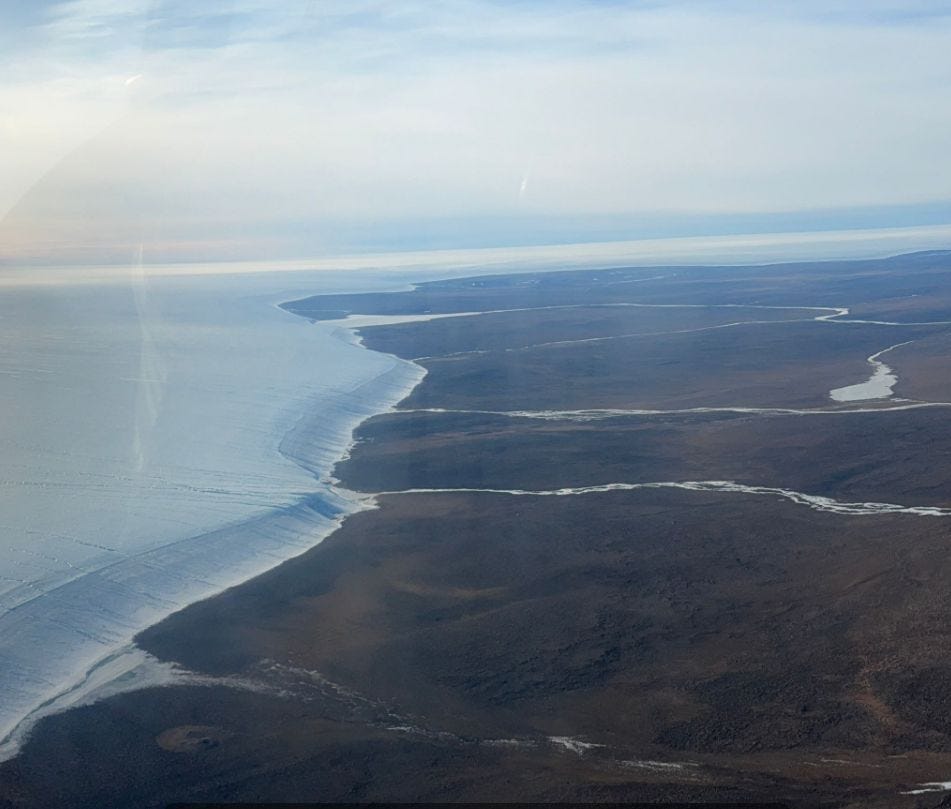
2025 field results were excellent - iron assays up to 69.5% Fe (with multiple samples in the 66-69% range) across a 9km trend of magnetite-rich breccia and iron-oxide alteration, sufficiently clean of impurities to suggest potential as DSO for Direct Reduced Iron products.
A parallel electromagnetic anomaly alongside the main magnetic trend returned anomalous copper and gold-pathfinder soil results, raising the prospect of a copper-gold-bearing sulphide zone sitting alongside the iron core — exactly the multi-commodity signature that defines an IOCG system.
Reprocessing of historic data also identified a much larger 80km linear zone than previously appreciated.
Scout drilling, mapping and ground geophysics are planned for the current season to test the copper-gold targets and better define the system’s scale.
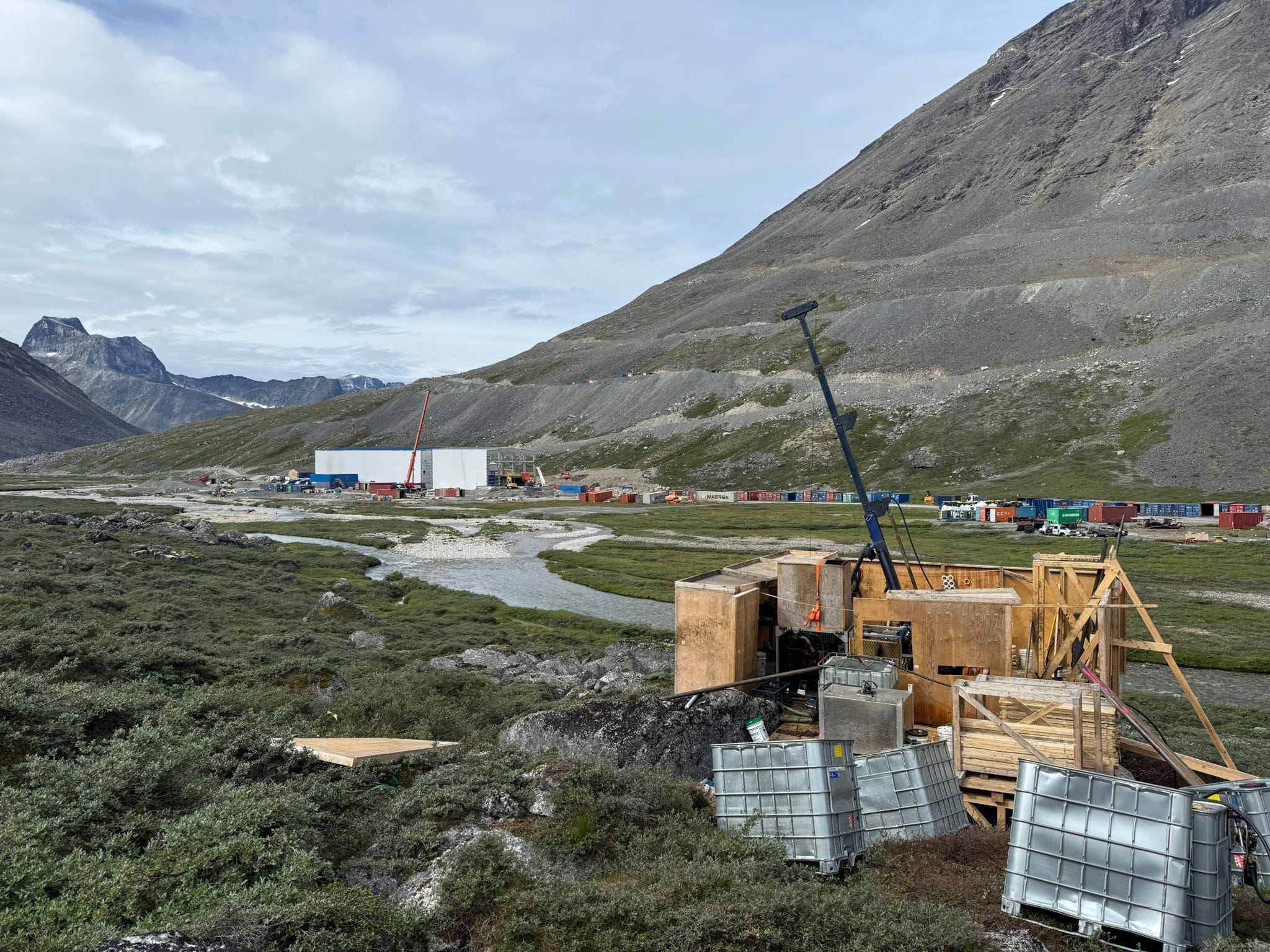
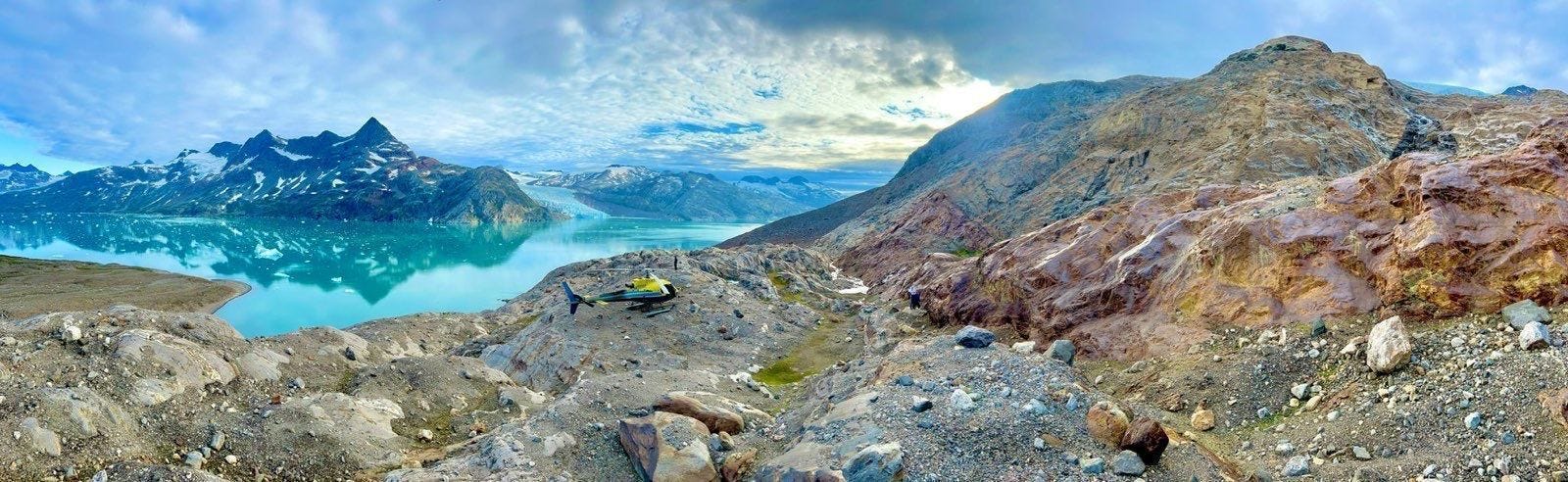
There’s one obvious advantage and one obvious drawback when it comes to project development - this land is, as pictured above, flat as a pancake compared to Nalunaq which is an actual mountain. But it’s also in the North, which is inarguably harder to operate in.
But if any company has the operational experience to make this work, Amaroq does.
5.3 Stendalen
A nickel-copper-cobalt prospect where drilling has already intersected disseminated mineralisation over 140+ metres; the internal comparison being drawn is to Vale’s Voisey’s Bay deposit in Canada (roughly 141Mt @ 1.6% Ni, 0.9% Cu, 0.1% Co).
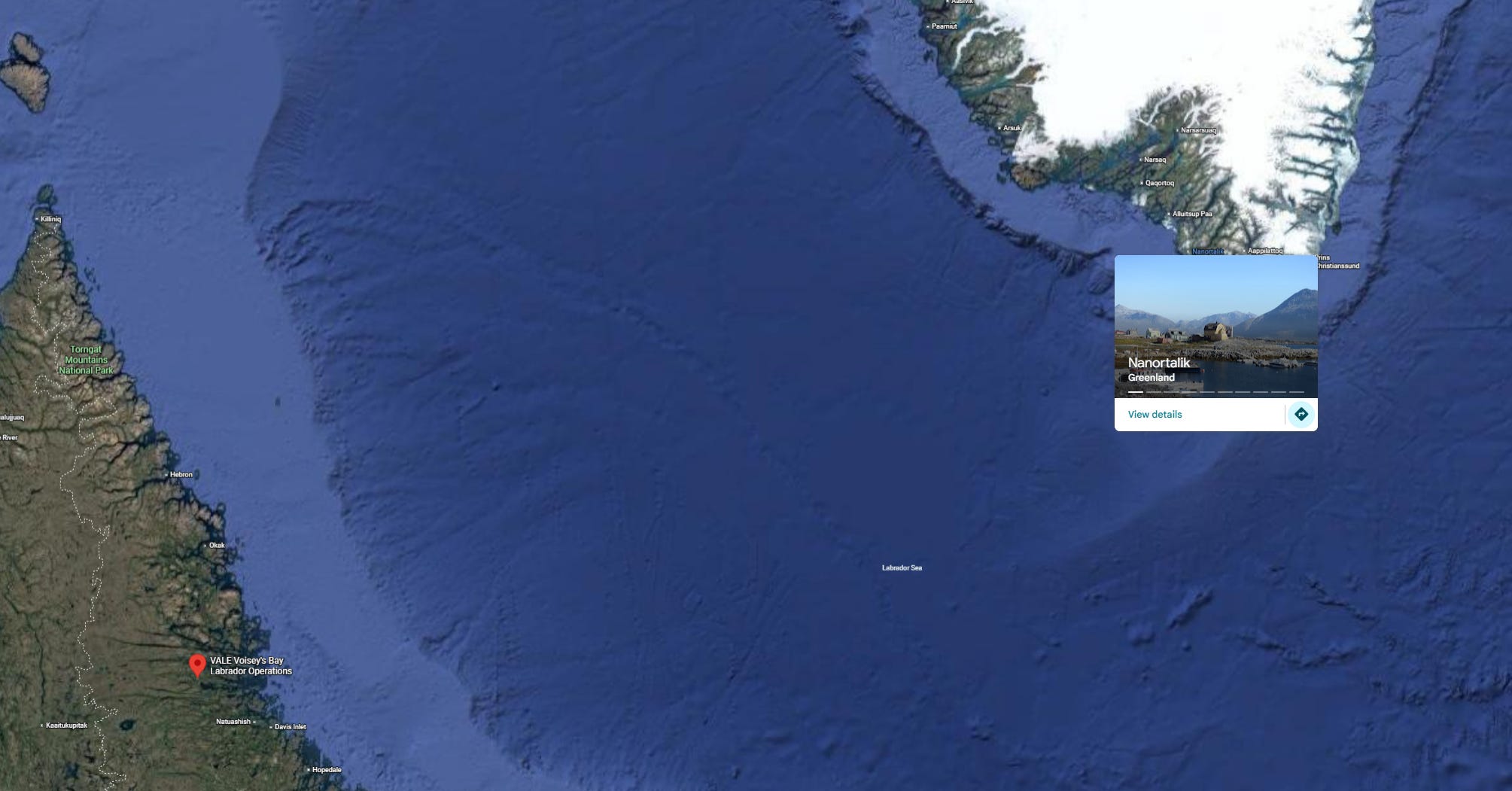
Additional drill sites targeting potential massive sulphide traps are being developed for the current field season.
5.4 Gardaq funding
In July 2026, GCAM and Amaroq signed a subscription agreement injecting fresh capital into Gardaq to fund the 2026/27 Ilua and Minturn programmes — C$4.7m from GCAM and C$1.8m from Amaroq immediately, with a further C$3.0m from Amaroq committed within a year (to be satisfied via conversion of accrued overhead/G&A rather than fresh cash).
Ownership splits remain unchanged at 51/49. In effect, the exploration engine behind three of the six live 2026 programmes is funded independently of Amaroq’s own operating cash flow.
6. Beyond the Named Projects: Regional Gold and the Enabler Businesses
6.1 Satellite gold discoveries
A 2025 regional programme collected 540+ surface samples across 11 licences in the wider Nanortalik Gold Belt and southwest Greenland, confirming multiple new gold zones: Vagar’s Q-North Ridge (up to 28.6 g/t Au over a 2km alteration corridor), Anoritooq’s Isortup Qoorua (up to 38.7 g/t Au and 1.98% Cu — a genuine gold-copper system), Napasorsuaq near Nalunaq itself (up to 3.58 g/t Au and 0.54% Cu), plus new discoveries at Tartoq, Ippatit and Grænseland.
None of these are resource-stage yet, but they extend the pipeline of potential future satellite feed for the Nalunaq mill well beyond Nanoq alone, and several are now being well progressed.
6.2 Suliaq
Amaroq’s wholly owned services and logistics subsidiary, formed to supply equipment, consumables and support to Greenland’s broader mining sector — leveraging the fact that Amaroq is the only company to have actually solved Greenlandic mining logistics from scratch.
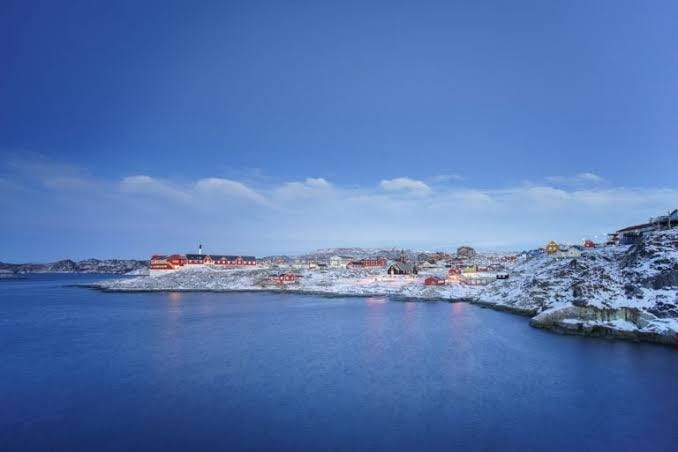
Independent equity financing discussions are underway, with EIFO (Denmark’s state-backed investment fund and a major Amaroq shareholder) having completed initial screening and expressed non-binding interest in participating in a targeted $20-35m raise for the subsidiary, alongside Greenland-based partners.
A financing close is being targeted for Q2/Q3 2026.
If completed, it both validates Suliaq’s standalone value and hands Amaroq additional rigs and equipment to accelerate exploration elsewhere in the portfolio.
The key point here is that it will give Amaroq and any other explorer across the island a win-win; AMRQ can be involved in every early discovery, while juniors can benefit from a cost-effective experienced operator.
6.3 IMEQ hydro
A small hydroelectric development near Nalunaq (at least 1 megawatt), intended to cut mine operating costs by an estimated $2 million annually, with environmental and social impact licences already secured and final permits targeted for 2026. This will be a long-lived (perhaps 50+ year) infrastructure asset that outlasts any single mine’s operating life.
7. The Financial Picture
7.1 What’s changed
The balance sheet has shifted from what I viewed as a debt-free fortress to closer to actively financed growth.
Year-end 2025 cash stood at $27.2m (CAD) with $8.9m in undrawn facilities and net debt of $15.3m. By Q1 2026, cash had fallen to $8.8m as capital assets grew to $275.4m, reflecting the capital intensity of completing Phase 2 and building the owner-operator mining fleet.
In April 2026, Amaroq refinanced and doubled its revolving credit facility to $70m with Landsbankinn and Gunvor Group, extending maturity to May 2028 and reducing the funding margin (7.50% over SOFR, stepping down to 4.50% as LTM EBITDA passes CAD 70m).
Gunvor — one of the world’s largest physical commodity traders — also took on gold offtake from Nalunaq as part of the deal, which is itself a signal - a major physical trader underwriting offtake is a clear vote of confidence in sustained production.
7.2 Revenue trajectory
FY25 revenue was $27m from 5.31koz of gold sales, along with a gross profit of $11.1m but an operating loss of $18.2m (reflecting the commissioning-year cost base).
Q1 2026 alone delivered $18.9m in revenue and a net profit of $2.4m — a different run rate, and one that will accelerate further as flotation recovery runs closer to target rates through H2 2026.
The increased leverage is real, but it’s financing tied to a specific, time-bound capital programme — Phase 2 flotation and the owner-operator fleet transition — rather than open-ended cash burn.
The margin step-down structure explicitly rewards EBITDA growth, and the facility is paired with an offtake relationship rather than existing in isolation.
8. The Geopolitical Layer
Greenland’s strategic profile hasn’t diminished since the USA first floated the ‘island Trump wants’ narrative — if anything, it’s sharpened.
The island hosts roughly 40 minerals the US government considers critical to national and economic security. China’s export restrictions on gallium, germanium, graphite, tungsten and since 2023 have forced Western governments to treat critical-mineral supply as a national-security question rather than a purely commercial one.
Precedents are accumulating - the US Department of Defense’s combined loan/equity/offtake package for MP Materials (around $550m in total), Export-Import Bank interest in Greenland’s Tanbreez rare-earth project, and the EU’s ‘strategic’ designation for the nearby Amitsoq project under the Critical Raw Materials Act.
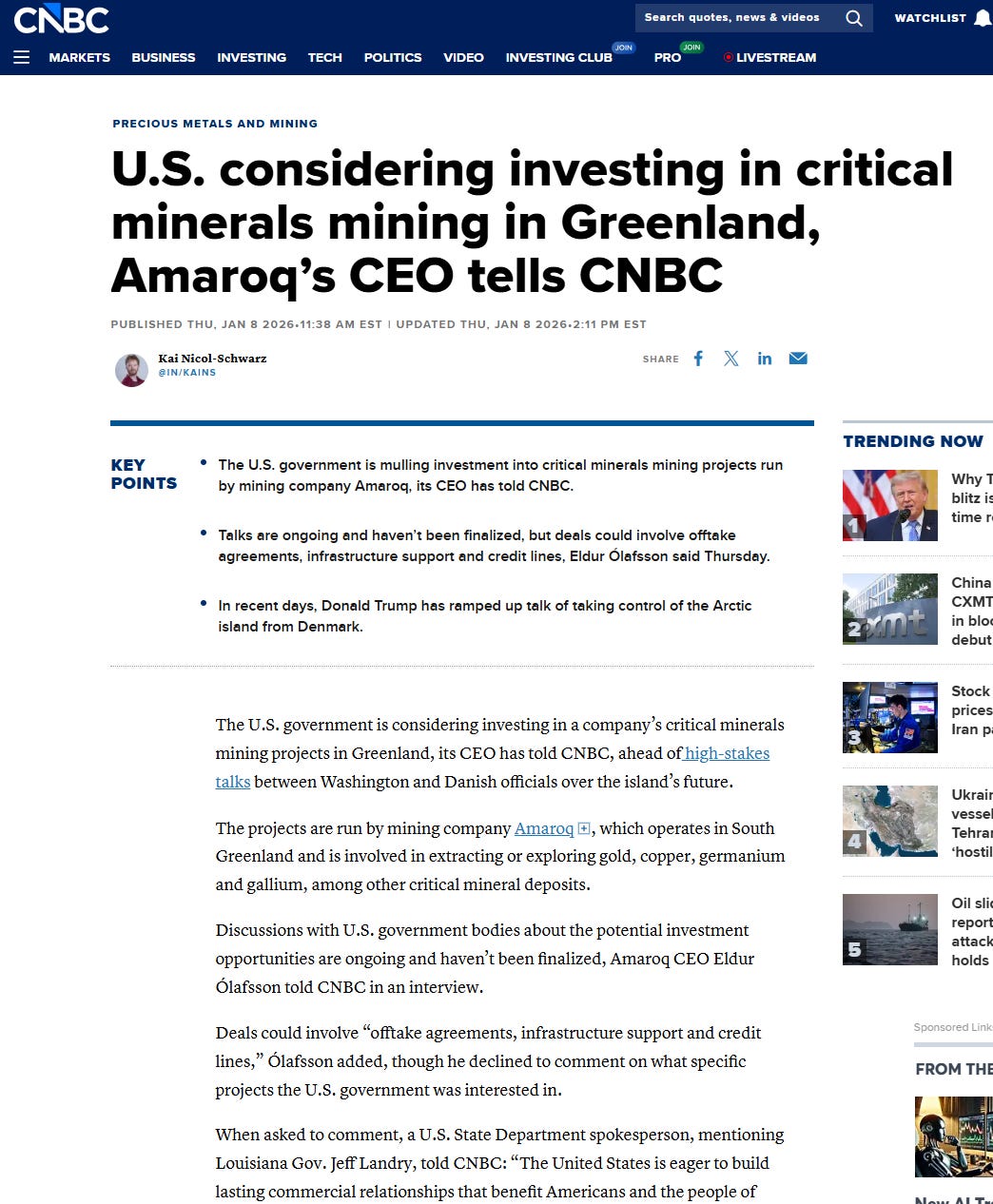
CEO Eldur Olafsson has been on the record for over a year describing active, ongoing engagement with state-backed agencies ‘on both sides of the Atlantic’ around offtake agreements, infrastructure support and credit lines — first via Bloomberg in mid-2025, then reiterated through 2026 interviews.
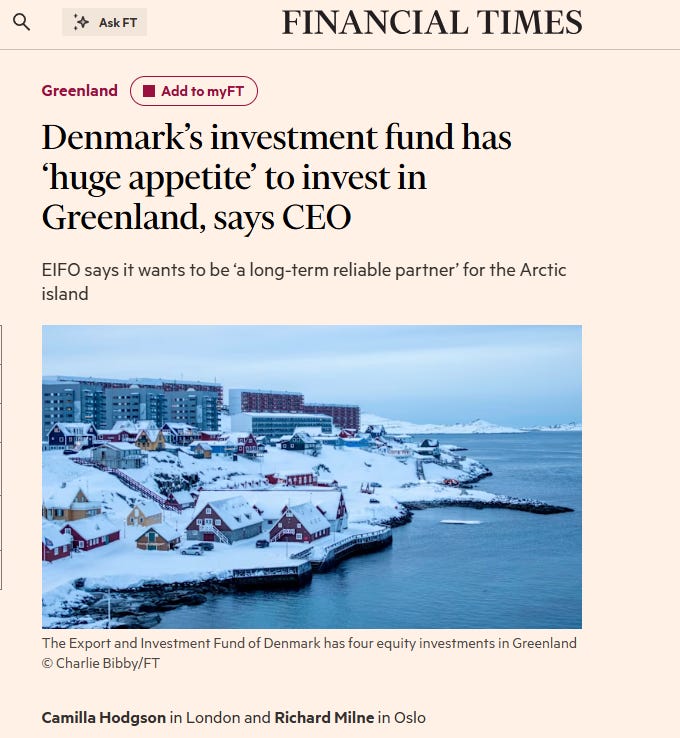
Denmark’s state-backed EIFO fund is already a major Amaroq shareholder and as noted above has separately screened a potential Suliaq investment.
None of this has yet converted into a US-based signed, binding government offtake or investment specific to Amaroq’s critical-minerals projects — that remains the single largest unpriced call option across the whole portfolio.
But the combination of Amaroq’s position as Greenland’s largest licence holder, its unique operational track record, and Black Angel’s newly-discovered germanium/gallium profile places it about as close to the front of that queue as any company plausibly could be.
9. Why Q4 2026 Specifically?
Layer all of the above onto a calendar and the reason for calling Q4 the OVERDRIVE quarter becomes mechanical rather than promotional:
Structural re-rating event: Main Market admission (31 July) opens FTSE index eligibility for the first time, right as the AIM index deletion removes the old constituency.
Production inflection: Q4 alone is guided at 10-12koz gold, roughly a third of the full-year range, as flotation recovery reaches its 90-95% target and unit costs fall to guided AISC of $1,250-1,450/oz.
Nanoq resource newsflow: the Central Zone drill programme running through July/August is specifically designed to deliver the data density needed for a maiden resource estimate.
Three Gardaq programmes reporting in parallel: Ilua REE assays, Minturn IOCG scout drilling, and Stendalen sulphide-trap targeting are all active in the same window, freshly funded by the July subscription agreement.
Black Angel and Kangerluarsuk: 2026 geophysics and drill-target design work is underway now, feeding toward the resource-growth programme that underpins the 2028 restart case.
Suliaq financing: a targeted Q3 2026 close would, if it lands, crystallise an independent valuation for the services business and hand the company additional exploration capacity.
No single one of these is unprecedented in isolation — Amaroq has delivered on individual catalysts before.
What’s different about this window is the catalytic density: a gold producer moving into steady-state cash generation, a maiden discovery-stage resource pending, three separate critical-minerals exploration programmes reporting, a financing event for a subsidiary, and a structural index-eligibility event, all inside roughly one quarter, on a company that a year ago was still working through commissioning.
10. The Bottom Line
Amaroq’s core claim to attention has never really been any single deposit — it’s that nobody else has proven they can actually build and operate in Greenland, and that operational capability compounds.
A year on from initiation, most of what was conditional then has become factual now- Phase 2 is commissioned and producing concentrate, the Nalunaq resource has grown again, Black Angel’s critical-minerals angle is confirmed rather than speculative, exploration funding for the Gardaq JV is secured through the current season, and the Main Market listing — the mechanism for unlocking a different class of institutional capital — happens tomorrow morning.
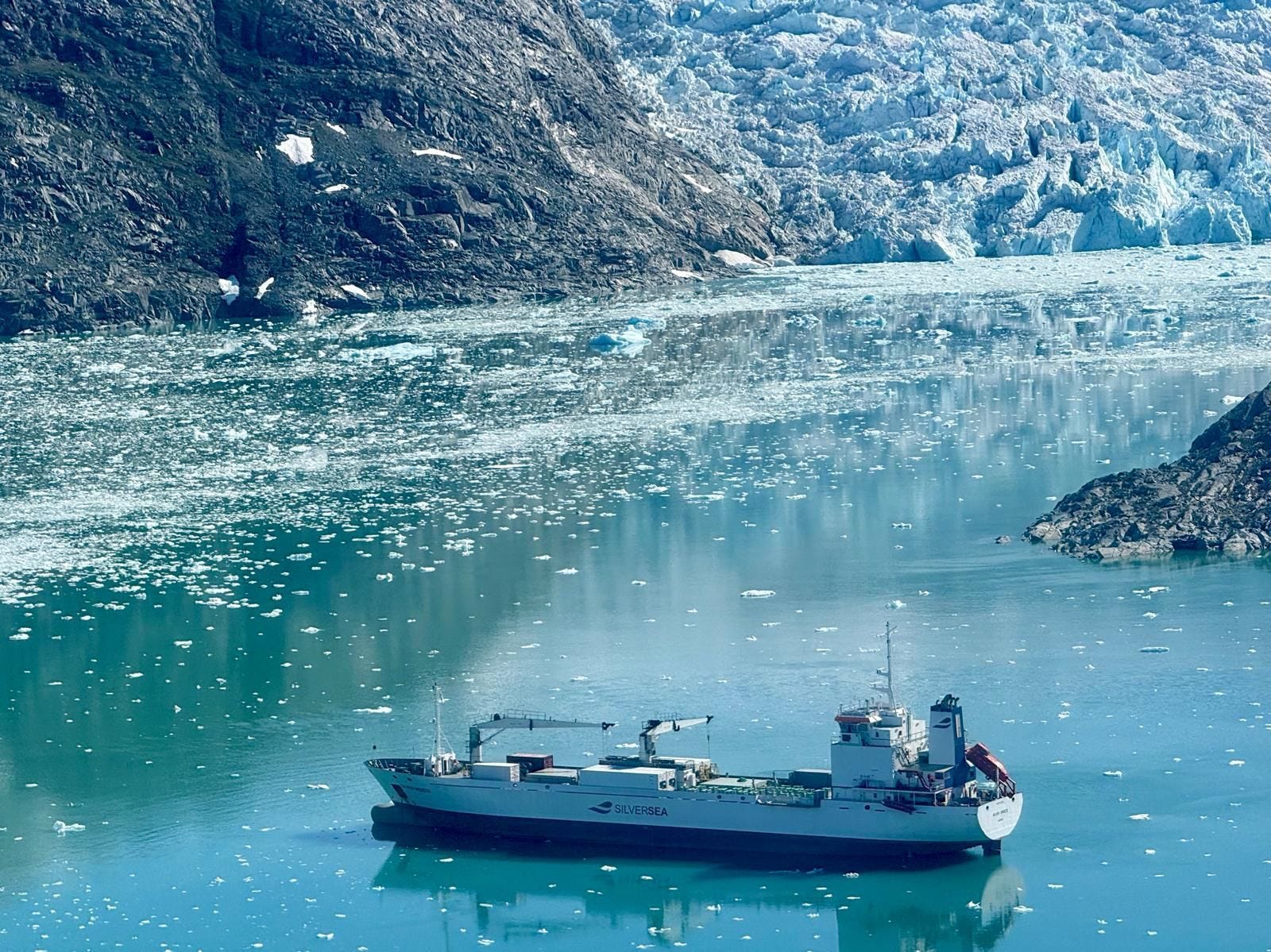
What hasn’t yet resolved — Nanoq’s maiden resource, a binding government commitment on critical minerals, confirmation of IOCG-scale mineralisation at Minturn, Ilua’s subsurface continuity — is what’s scheduled to report over the next two quarters.
That’s the shape of my Q4 thesis: not a single catalyst to watch, but the first quarter in the company’s history where production, discovery, financing and index mechanics are all moving at once.
Greenland can be done. Citi clients will watch them prove it in real time.
Major institutions can now buy in.
And the FTSE 250 calls.
Great writup as always. I own far too much Amaroq but the sorry is so compelling. It’s got all the making of a great double bagger. I hope you’re enjoying the holiday season.
"On holiday" but what a detailed and thorough breakdown of Amaroq. This company is going to be huge. Cash generative allowing expansion. Will a TO bid come in? Probably