

African Summer
Six potential winners.

Good Morning Team.
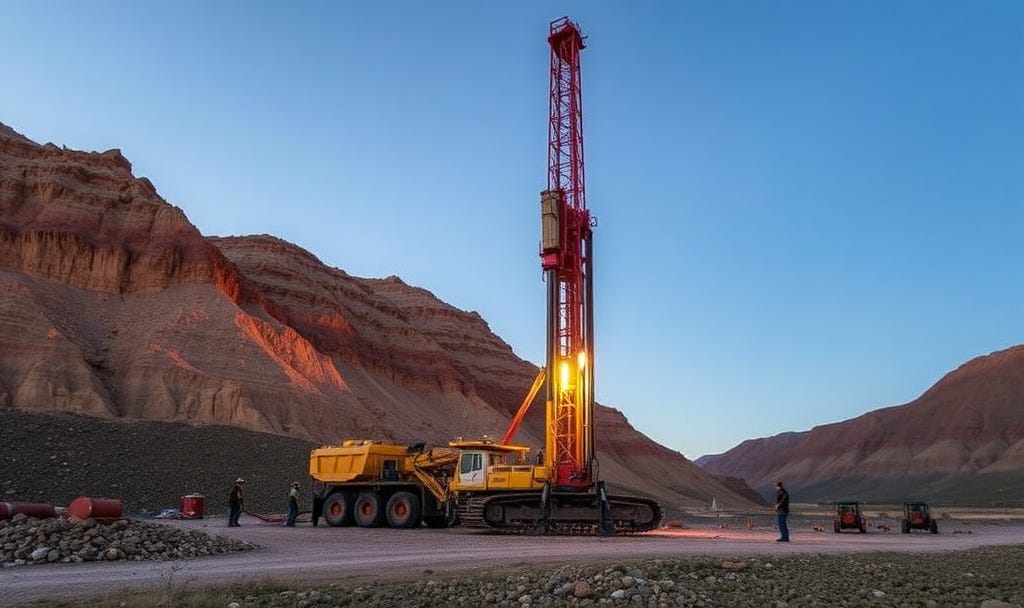
One of the more enjoyable aspects of junior resource investing - where we spend a considerable amount of time - is when your company of choice has stopped messing about with surface exploration, geophysics, surveys, computer modelling, rock chip samples and increasingly AI - and actually made the corporate decision to commit to the bit.
The drill bit, that is.
As a caveat, if they haven’t done the initial surface homework, they will fail the drill exam. All the (frankly quite dull) stuff that comes beforehand is exceptionally important and informs which companies I back.
Those who have narrowed down their drill pad locations to the best possible location have a better chance of success. It really is that simple - though it’s also true that the market doesn’t have the patience to wait years.
At some point, you really do just have to go for it.
As far as I’m aware (and I would love to be corrected on this, so please do so if you can), every major commercial find has required drilling.
Surface geology, geophysics, geochemistry and AI are highly effective at finding anomalies.
These are places where, in super scientific terms, the rocks look interesting or different.
However, they cannot confirm a financial success because:
Only a core or chip sample pulled from the ground can prove the actual percentage of metal involved (grade) and how wide the zone is (thickness).
Geophysics can suggest a shape underground, but drilling physically maps the depth, dip and structural continuity of the rock.
To publish a JORC/NI 43-101 (or similar) mineral resource estimate that banks will finance, a company must have physical data points.
And despite the many technological wonders of 2026, there’s a simple joy in the reality that to make a lot of money in this game, you have to risk some of it by making a hole in the ground with a big metal stick.
As a general rule (with some very rare exceptions), I find the best time to invest in junior resource plays is after the pre-drill work is complete but before the programme has started.
As per usual, milking stool theory applies.
Assets, management, capital.
The drill target should look like it has a reasonable chance of success and be targeting something decent.
If you’re going to risk a duster, the upside has to be worth it.
Management should ideally have has successes before.
Capital - be under no illusion. Juniors are on the public market to raise capital. That’s the primary reason they’re here.
In this bull market, the terms are much more reasonable than in the recent past, but buying after the raise to pay for the next round is no bad idea. Ideally, your company of choice has the cash to drill with a healthy buffer for working capital and contingency risks.
That all being said, I want to highlight the following small caps, all drilling in Africa this calendar year with a potential re-rating possible in the event of success.
For clarity, my hope is that all hit an OTD-150 but ultimately the name of the game is to spread capital across some of the best prospects - accept some will win immediately and others will need to try again.
There’s no shame in this by the way.
Exploration carries risk.
The good news is that by combining your own research with the reality that the vast majority of explorers are on a hiding to absolutely nothing, you can identify alpha in what is essentially the last under-researched corner of the stock market.
These are companies that have not yet re-rated - they don’t have defined resources, and they don’t have massive market valuations.
But they do have one thing going for them.
They’ve got news coming.
Six stocks to watch for assays
1. Switch Metals
Switch has seen its market cap climb to £16 million since our last look, a reflection of growing market awareness as the company officially transitions from the planning stage to the point of no return.
The dull work of grid-based pitting, soil sampling and wash plant processing at the Issia project is now complete, and the company is currently in the final stages of data interpretation and geological modelling.
With the resource washing programme concluded, we are effectively in the final countdown to the release of the maiden Mineral Resource Estimate (MRE-1).
This is the moment where the homework is finally marked, and the market will see if the physical grades and tonnages align with the investment thesis.
The true pivot point, however, is the move from shallow placer resource definition to the hard-rock drilling programme.
Switch has already defined two high-priority targets at Kabore and Zraty — the former holding a significant spodumene-bearing lithium discovery and the latter representing some of the highest-grade tantalum identified in their portfolio.
With approximately 2,500 metres of scout drilling planned to test the down-dip extensions of these pegmatites, the company is finally committing to the bit.
This is an excellent technical setup - the company has defined its geological targets based on solid surface data, secured the capital to execute the programme, and possesses a management team that is prioritising a methodical path to production.
The broader commercial narrative remains just as compelling.
By positioning itself as a secure, ethically traceable and non-DRC source of critical minerals, Switch is directly addressing the strategic anxiety currently gripping Western defence and technology supply chains.
With a $5 million, low-capex Phase 1 strategy that aims to leverage existing gravity separation to reach cash flow, they have built a business model that is arguably one of the most capital-efficient plays in the sector.
There are very few lithium explorers out there - and as this theme comes back into vogue, Switch is positioned to capture investor attention.
2. Arc Minerals
Arc Minerals is my longest-held thesis on this list.
For years, investors have known the company primarily through its extensive landholding in Zambia’s Western Domes region, where it assembled one of the best exploration footprints in the Central African Copperbelt and ultimately attracted mining giant Anglo American into a joint venture.
The problem has never been the geology.
A combination of legal disputes, corporate complexity and changing priorities among major mining companies meant that despite significant exploration success, shareholders have endured a prolonged period in which the underlying asset value failed to translate into market performance.
That situation now appears to be changing.
The first major development came in October 2025 when Anglo American exited the Zambian joint venture.
While this was a negative, it’s not a disaster.
Anglo left behind approximately $800,000 in the project vehicle while returning control of the licences to Arc, allowing management to pursue alternative development pathways and potential strategic transactions without the constraints of a major partner.
More recently, Arc announced a comprehensive settlement agreement resolving all outstanding litigation in Zambia.
This is arguably one of the most important developments in the company’s history.
For years, legal uncertainty has lingered in the background as a persistent overhang on the valuation of the business. The settlement removes that distraction, confirms ownership of the company’s key licence holdings and allows management to focus entirely on advancing exploration rather than fighting court battles.
Others who lost their major JV partner in this region of the world returned to record highs.
It can happen here too.
However, the reason Arc is on this specific list is Botswana.
The company’s Virgo Project sits within the Kalahari Copper Belt’s highly prospective Zone 5 - the same structural corridor that hosts major discoveries and resource developments by MMG and other operators.
Arc controls the only junior-owned licence position within this corridor.
Accordingly, by some metrics, it has the best exploration licence in the Kalahari Copper Belt.
Throughout the first half of 2026, Arc has been completing an extensive geophysical programme across Virgo. The work includes 295 line kilometres of detailed magnetic surveying and 52.5 kilometres of induced polarisation surveying designed to identify and refine the key D’Kar-Ngwako Pan formation contact, the geological horizon responsible for hosting many of the Kalahari Copper Belt’s major copper deposits.
Previous drilling and geophysics have already confirmed the presence of this contact and associated mineralisation on the licence.
The current programme is designed to transform that geological understanding into drill-ready targets.
Drilling is expected to start during the H2.
That is the critical inflection point.
For several years, Arc’s valuation has largely reflected historical achievements, corporate events and legal developments rather than new exploration momentum. Virgo has the potential to change the narrative entirely.
The company recently completed a £3 million fundraise specifically to advance exploration in Botswana, ensuring that the next phase of work is fully funded.
3. Serval Resources
If Switch represents the final stages of target definition before drilling, then Serval Resources is a textbook example of how a serious exploration company should be building towards a major campaign.
The company only arrived on AIM in April, but the pace of execution has been impressive.
Since listing, Serval has already delivered multiple geophysical updates from Botswana and, this week, its first field mapping results from the Kaoko Basin in Namibia. More importantly, every piece of news appears to be reinforcing rather than weakening the original investment case.
For those unfamiliar with the story, Serval controls more than 2,000 km² of prospective ground across Namibia and Botswana, positioned in two of the most exciting sediment-hosted copper districts on the planet.
The Namibian licences sit within the Kaoko Basin, which is widely regarded as a geological extension of the Central African Copper Belt, while the Botswana portfolio occupies strategic positions across the Kalahari Copper Belt alongside operators including MMG, Sandfire, South32 and Cobre.
The market naturally gravitates towards drilling, but before a drill rig arrives you need evidence that you are pointing it in the right direction.
That is exactly what Serval has been doing.
The latest mapping programme on EPL 7081 and EPL 7079 confirmed visible copper mineralisation at surface across multiple target areas, including Omatapati and Horseshoe.
At Omatapati, the geological team identified copper mineralisation extending beyond the previously defined area, potentially opening up strike extensions to the southeast.
At Horseshoe, mineralisation was observed around a large folded structure with additional expressions identified along the same stratigraphic horizon.
Meanwhile, on EPL 7079, geological mapping confirmed the presence of the same redox boundary setting associated with the nearby Okohongo copper-silver deposit. For exploration geologists, these are the kinds of observations you want to make before spending shareholder money on drilling.
Nobody is claiming to have discovered the next Tier 1 copper mine because they found some green rocks at surface. What the company is doing is systematically narrowing the search area, improving its geological understanding and building confidence in where future drill holes should be placed.
That matters.
Because the Namibian assets already contain historical drill intercepts that would turn heads in many junior explorers.
Omatapati has previously returned 20 metres at 1.2% copper and 41 g/t silver, including 5 metres at 2.4% copper, together with a separate 27-metre interval grading 0.59% copper and 34 g/t silver.
The current work is focused on understanding how large that mineralised system might ultimately become.
The next major catalyst remains the first AIM Serval-operated drilling campaign, currently expected in the second half of 2026.
That programme is intended to test strike extensions, expand known mineralisation and begin laying the groundwork for a maiden resource.
The attraction here is straightforward.
At its current valuation, the market is assigning very little value to a land package surrounded by billion-dollar copper discoveries. The geophysics has been encouraging, the mapping is confirming the geological model and permits are in place.
The team has the funding.
Now they need to make some holes in the ground.
And if they hit, the re-rating could be substantial.
4. Aterian
One of the recurring frustrations with junior explorers is that they can become trapped in a perpetual cycle of target generation.
More mapping.
More geophysics.
More geochemistry.
More presentations explaining why the next round of work will finally identify the best place to drill.
At some point, investors need to see a company move to execution.
That is where Aterian appears to be heading.
The completion of the Lithosquare joint venture is more important than the headline €1 million exploration commitment might initially suggest.
What shareholders are effectively receiving is a fully funded exploration programme across nine projects in Morocco and Botswana without the usual dilution that accompanies aggressive field campaigns.
The revised structure also appears shareholder friendly. Lithosquare earns an initial 15% project interest through expenditure rather than Aterian issuing equity, preserving exposure to any discovery success while simultaneously accelerating exploration activity.
Most importantly, the programme now has defined deliverables.
At Agdz and Azrar in Morocco, approximately 1,500 metres of drilling are planned following geological mapping, trenching, geophysical surveys and AI-assisted target refinement.
These are not grassroots projects where geologists are wandering across a desert hoping to find something interesting. Agdz has already produced rock chip grades including 26.5% copper and 484g/t silver, while previous drilling confirmed copper-silver mineralisation at depth.
The objective now is straightforward: determine whether these high-grade surface occurrences connect into a larger mineralised system.
Meanwhile in the KCB, Aterian is progressing five licences through geochemistry, drone magnetics, induced polarisation and electromagnetic surveys ahead of roughly 1,200 metres of scout drilling.
For investors, the attraction of the Kalahari remains obvious.
This is one of the few globally significant copper districts where genuinely meaningful discoveries are still being made. MMG paid $1.7 billion for Khoemacau. Sandfire built Motheo. BHP is spending millions searching for the next major deposit.
Aterian controls a large land position in a postcode where major companies continue deploying capital.
What has changed over the past six months is that the company is no longer simply describing that opportunity.
It’s actively testing it.
At the same time, the Rwandan trading division continues to improve. Q1 2026 gross profit reached approximately $306,000, more than double the $145,000 achieved in Q4 2025.
While still small in the context of a future mining company, the trend is important because it demonstrates that management’s strategy of creating a cash-generating critical minerals platform is beginning to work.
Every dollar generated through trading is a dollar that does not necessarily need to be raised from shareholders.
The result is a company entering what is arguably its most interesting phase since listing.
The AI target generation work is complete.
The field programmes are underway.
The drill targets are being refined.
And for the first time, investors have a clear line of sight to multiple drilling campaigns across two highly prospective copper districts.
5. Critical Mineral Resources
Since my original coverage, Agadir Melloul has continued to deliver exactly what investors want to see from an emerging copper development project: more drilling, more mineralisation and growing confidence in both scale and continuity.
The company has now drilled over 6,700 metres across 176 holes, with drilling rates increasing to circa 1,200 metres per month as two diamond rigs operate on site.
Importantly, visible copper sulphide and oxide mineralisation continues to be encountered across multiple zones, supporting management’s view that Agadir Melloul represents a significant sediment-hosted copper system rather than a series of isolated occurrences.
The latest assay results have been particularly encouraging.
April results included 5.0 metres at 1.20% copper, 0.77g/t gold and 1.4g/t silver, including 3.0 metres at 1.64% copper and 1.16g/t gold, alongside 3.7 metres at 1.76% copper and 8.6g/t silver from just 6.3 metres depth.
Other intercepts included 7.0 metres at 1.06% copper and 7.0 metres at 0.91% copper, demonstrating both grade and continuity within the shallow mineralised system.
June’s drilling update added further support to the growing geological model, with hole BH157 returning 9.7 metres at 0.74% copper and 4.46g/t silver, including higher-grade sections of 2.2 metres at 1.05% copper and 3.6 metres at 0.98% copper.
While not the highest-grade result reported to date, the near-10-metre thickness is significant and mirrors the broader trend of mineralised widths exceeding the company’s original assumptions of around two metres.
Management has highlighted similarities between these thicker zones and parts of the nearby 130-million-tonne Tizert copper deposit, which remains the project’s principal geological analogue.
Perhaps most importantly, the company has now completed an internal block model ahead of its maiden JORC resource estimate, scheduled for September 2026.
(After the summer holidays. Good idea).
Management believes the current drilling density, typically on 50m x 100m and 100m x 100m spacing, should support substantial Measured and Indicated resource classification.
This is key.
Despite this progress, less than 5% of the prospective sedimentary target area has been drilled, leaving lots of room for resource growth.
Alongside resource drilling, metallurgical studies, process design work, geotechnical investigations and environmental permitting activities are all progressing.
The company remains on track to deliver a maiden resource in Q3 2026 followed by a feasibility study before year-end.
6. Arkle Resources
When I first covered Arkle earlier this year, the investment case centred on a simple proposition: an £8 million company had quietly assembled a substantial uranium position in Namibia’s Erongo Basin, one of the most productive uranium districts on the planet, while retaining meaningful exposure to one of Europe’s most prospective undeveloped zinc projects through its stake in Stonepark.
At the time, the thesis rested largely on location, surface sampling and geological analogy.
Today, it rests on something far more valuable.
Defined drill targets.
One of the greatest risks facing any early-stage explorer is that extensive geophysics and surface work ultimately fail to generate actionable targets.
Investors can spend years funding mapping campaigns, airborne surveys and technical reports without ever reaching the point where management feels confident enough to start drilling.
Arkle has now crossed that bridge.
The company’s Phase 1 geophysical programme in Namibia has successfully identified multiple drill-ready uranium targets across two distinct mineralisation styles.
The first comprises paleochannel-hosted uranium systems analogous to the nearby Trekkopje and Marenica deposits.
The second targets uraniferous leucogranites, the same style of mineralisation responsible for some of Namibia’s largest uranium deposits, including Rössing, Husab and Etango.
Rather than relying on a single geological concept, Arkle now has exposure to two proven deposit models within the same licence package, both supported by surface sampling, geophysics and regional analogues.
Most encouragingly, the company has accelerated drilling.
Management originally expected several additional months of mapping and target refinement following completion of the airborne surveys.
Instead, the quality of the data has allowed the timeline to be compressed significantly. A 1,500-metre reverse circulation programme is now expected to commence on the Eastern EPL 8995 paleochannel target as early as - well, right now - while trenching and sampling have already begun across a substantial leucogranite target measuring approximately one kilometre by seven hundred metres.
Subject to those results, a further 2,500 metres of drilling is planned during Q3.
What makes the story particularly compelling is the location. EPL 8995 sits directly adjacent to Orano’s Trekkopje deposit, one of the largest calcrete-hosted uranium deposits in the world and currently under assessment for restart.
The interpreted paleochannel structures identified by Arkle appear to extend towards the same mineralised system, while the leucogranite targets share characteristics with the broader uranium-bearing alaskite province that hosts Namibia’s world-class uranium operations.
The grades already identified at surface remain encouraging. Previous sampling returned uranium values of up to 2,782 ppm U₃O₈ from calcrete-hosted mineralisation and up to 3,855 ppm U₃O₈ from leucogranite-hosted material.
While surface samples can catfish you worse than Tinder, they provide useful evidence that the geophysical targets are not being generated in a geological vacuum.
Importantly, Arkle remains fully funded for approximately 4,000 metres of drilling across both target styles, ensuring investors should receive a steady stream of exploration news through the remainder of the year.
Meanwhile, the company’s Stonepark zinc asset continues to develop in the background.
Group Eleven, Arkle’s joint venture partner, has significantly expanded its planned drilling programme at Stonepark from approximately 3,000 metres to around 15,500 metres.
More recently, a drill rig has been mobilised for an initial four-hole, 2,700-metre campaign targeting the Stonepark deposit itself together with the Kilteely and Bruff prospects.
Stonepark already hosts an inferred resource of 5.1 million tonnes grading 11.3% combined zinc and lead and remains open in multiple directions. The project sits directly alongside Glencore’s Pallas Green deposit, one of the world’s largest undeveloped zinc assets, and continues to benefit from the growing geological understanding emerging from Group Eleven’s broader success across the Limerick Basin.
The significance here is that investors effectively receive two separate discovery opportunities.
The market is increasingly focused on the uranium story. They should be - Namibia is where the value inflection point appears most immediate.
However, Arkle also retains exposure to a high-grade Irish zinc project where a funded partner is actively drilling and advancing exploration.
A Final Word
In this space, the only thing that matters to investors is the drill bit.
These companies are collectively drilling - I would guess - around 40,000 metres - and all of those assays will land over the next few months.
They can all re-rate.
Happy hunting!
P.S. - special mention to Rift, which is fully funded for drilling in 2027 and beyond - and appears a good entry for those who understand the concept of patience.
Appreciated the ps, having recently added to my position in Rift.
Hopefully ARCM deliver the good news. If not, I expect the board to reduce their substantial salary packages